How long to stay in an infrared sauna
October 15, 2026

How Long Should You Stay in a Sauna?

Holistic Wellness, Heart Health, Sweat
Direct answer

Stay in an infrared sauna for 15 to 40 minutes, three to four times a week. Start at about 15 minutes and build from there as your body adapts; 30 to 40 minutes is the target for a regular user. Sunlighten’s own first-timer guidance is to begin with 10–15 minutes at 100°F every other day and work up toward 40-minute daily sessions.

Written by: Bri Partidge

The reason those numbers aren’t arbitrary: 15 minutes is roughly where sweating reaches its maximum rate, 20 minutes is where most of the clinical trials that produced measurable results actually sat, and in the largest long-term cohort study of sauna bathing, the risk curves for men who stayed longer than 19 minutes separated clearly from those who stayed under 11. Consistency matters more than any single long session — frequency showed a stronger association with outcomes than duration did.

Session length at a glance

  • First session: 10–15 minutes, every other day, at 100°F.
  • Building tolerance: 20–30 minutes, 3–4 times a week, at 110–120°F.
  • Regular use: 30–40 minutes, 4–7 times a week, at 120–130°F.
  • Practical ceiling: 40 minutes at 130°F.

Source: Sunlighten first-timer protocol, which specifies 10–15 minutes at 100°F every other day to start, “no more than 15 minutes” the first time, an average range of 100–129°F, never above 130°F, and 40-minute daily sessions as the build target.

Why 15 minutes is the floor

Fifteen minutes is not a soft recommendation. It is approximately where the body’s sweat response saturates.

A systematic review in the Journal of Environmental and Public Health states the physiology plainly: as thermal load rises, blood flow to the skin increases from a baseline of 5–10% of cardiac output to 60–70%, and “maximal sweating occurs within 15 minutes” (Sears, Kerr & Bray, 2012, citing Eisalo & Luurila). Leaving before that point means leaving before the physiological response you came for has fully switched on.

Core temperature follows a similar curve. Internal testing on a Sunlighten Solo cabin, measuring one subject’s core temperature every minute, found it rose almost 3°F across a 30-minute session and stayed elevated for another 30 minutes afterward (Sunlighten Core Temperature Study, internal single-subject data). The heat load keeps accumulating well past the 15-minute mark — which is the argument for 30 to 40 minutes once you’re acclimated, not just 15.

What session length the clinical research actually used

This is the most useful reality check available, and it clusters tightly between 15 and 30 minutes.

  • Imamura et al., Journal of the American College of Cardiology, 2001: 15 minutes at 60°C, then 30 minutes wrapped in blankets, once daily for 2 weeks. Flow-mediated vascular dilation improved from 4.0% to 5.8% (p<0.001) in 25 men with coronary risk factors. (Study)
  • Beever, Canadian Journal of Diabetes, 2010: 20 minutes, 3 times a week for 3 months. Systolic blood pressure fell 6.4 mm Hg (p=0.05) in adults with type 2 diabetes, with a 75% completion rate.
  • Mero et al., SpringerPlus, 2015: 30 minutes at 35–50°C after training sessions. Countermovement-jump recovery was significantly better than with no sauna. (Study)
  • Olson, Auburn University at Montgomery (Sunlighten-sponsored): 30 minutes (20 minutes rest plus 10 minutes stretching) in an mPulse, single-session crossover. Seated low-back and hamstring reach improved 2.15 inches in the sauna vs. 1.0 inch in a 70°F room.

Note what is not on that list: a study showing that an hour beats 30 minutes. The research that produced measurable cardiovascular, recovery, and flexibility results ran sessions of 15 to 30 minutes.

The Beever trial is worth dwelling on, because it used a Sunlight (now Sunlighten) sauna and because its most interesting finding wasn’t the blood pressure number. It was adherence: 75% of participants completed three months of thrice-weekly sessions, which the author notes “is significantly better than adherence to other lifestyle change.” Participants described it as “like exercise without exercising.” A 20-minute session people actually do beats a 60-minute session they quit in week three.

What the long-term data says about duration and frequency

The largest body of evidence on sauna dose comes from the Kuopio Ischaemic Heart Disease cohort — 2,315 Finnish men followed for a median of roughly 20 years. It is traditional Finnish sauna at 80–100°C, not infrared, so it cannot be read across directly. What it can tell you is the shape of the dose-response relationship.

As summarized in Laukkanen, Laukkanen & Kunutsor, Mayo Clinic Proceedings, 2018:

By session duration (more than 19 minutes vs. 11 minutes or less):

  • Sudden cardiac death: hazard ratio 0.48 (95% CI 0.31–0.75)
  • Fatal coronary heart disease: hazard ratio 0.64 (95% CI 0.46–0.88)
  • Cardiovascular mortality: hazard ratio 0.76 (95% CI 0.59–0.97)

By frequency (4–7 sessions a week vs. 1 or fewer):

  • Sudden cardiac death: hazard ratio 0.37 (95% CI 0.18–0.75)
  • Fatal coronary heart disease: hazard ratio 0.52 (95% CI 0.31–0.88)
  • Cardiovascular mortality: hazard ratio 0.50 (95% CI 0.33–0.77)
  • All-cause mortality: hazard ratio 0.60 (95% CI 0.46–0.80)

Two things to take from this. First, the duration threshold that separated the groups was 19 minutes — which is why “about 15, building toward 30” is a defensible floor and not an arbitrary one. Second, the frequency associations are stronger than the duration associations across every outcome. Going four to seven times a week was associated with a larger reduction than staying longer per session was. If you have to choose between adding ten minutes and adding a day, add the day.

The same review notes that typical Finnish sauna sessions run “from 5 to 20 minutes” and declines to issue a prescription, advising instead that it is “prudent to start with caution, to check the individual tolerance, and to increase the intensity and frequency of the activity gradually.” That is the same advice as “start low and slow,” arrived at independently.

Why “how long” is really “how long, at what dose”

Time is a proxy. What the body responds to is total infrared energy absorbed, and that depends on how much usable infrared the cabin is actually delivering.

Two saunas set to the same temperature for the same 30 minutes can deliver materially different doses, because delivered dose is governed by heater surface temperature (which sets the wavelength), emissivity (how much energy is emitted as usable infrared rather than reflected), and whether delivery stays constant across the session or drifts as the heater cycles. Independent testing by Bruker Analytical Services measured SoloCarbon® at 0.95 emissivity and SoloCarbon® Custom Spectrum at 0.99, versus 0.93 for a standard carbon surround heater (Bruker Analytical Services, March 1, 2022).

This is why session length should be read as a floor, not a specification. Fifteen minutes in a cabin delivering a well-controlled 9.4-micron far-infrared dose is not the same intervention as fifteen minutes in one that isn’t.

mPulse programs: when the sauna decides the length for you

On mPulse®, you don’t set a timer and guess. You choose a goal, and PulseIQ™ delivers the right wavelengths at the right dose, timing, and pulsation for it.
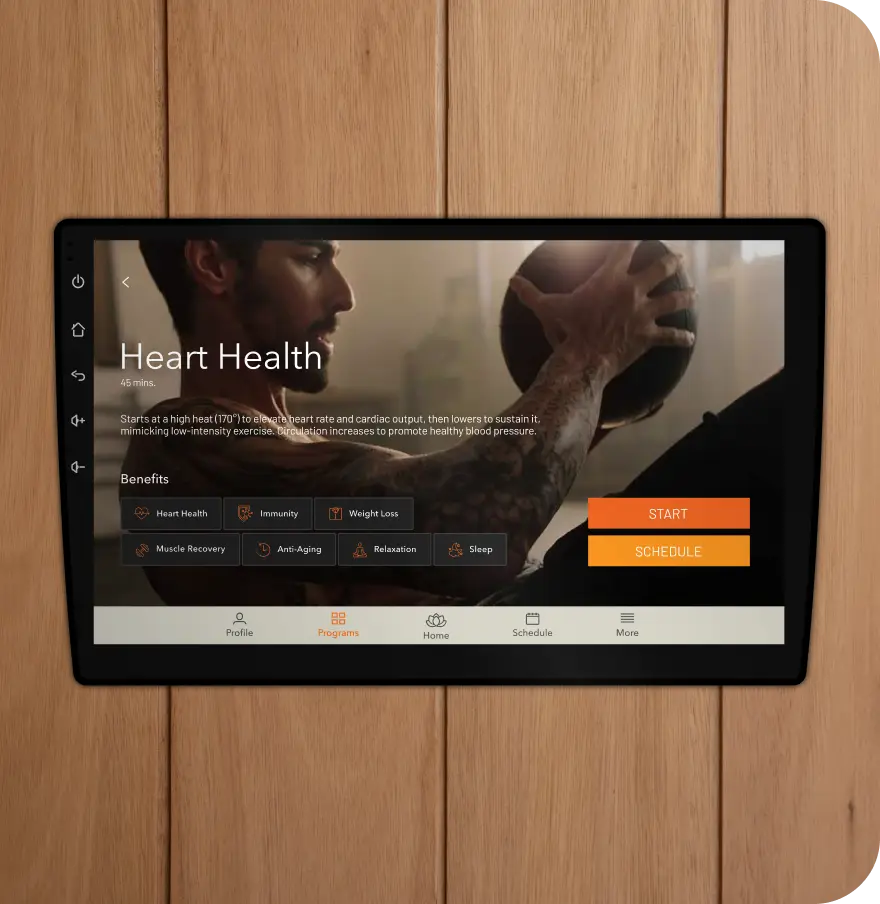
Choose today’s wellness goal. mPulse handles the rest.

What your body needs changes day to day. PulseIQ controls the intensity and depth of each wavelength to deliver targeted infrared energy, so you get the wellness benefits you need to feel better every day. Choose a program from the sauna screen or Sunlighten app, settle in, and let your mPulse Intelligent Sauna do the work.

FIR

MIR

NIR

RED

45 min.

Heart Health

SUPPORT YOUR HEART WITHOUT THE STRAIN

Starts at a high heat to elevate heart rate and cardiac output, then lowers to sustain it, mimicking low-intensity exercise. Circulation increases to promote healthy blood pressure.

↓6.5 mmHg reduction in systolic blood pressure*

*Clinical study using Sunlighten SoloCarbon® heaters, UMKC (2005)

The Sunlighten mPulse Smart Sauna tablet screen displaying the customized heart health wellness program.

The only infrared sauna with wellness programs built from 37 clinical studies.

These are not six labels on the same heat cycle. Each program is engineered separately, because each condition is different. Heart Health is the most intense; Anti-Aging is the gentlest, and deliberately so. Heart Health runs as a 45-minute program — it starts at a high heat to elevate heart rate and cardiac output, then lowers to sustain it, mimicking low-intensity exercise.

That design point answers the “how long” question differently: the right session length for a recovery session is not the right session length for a skin session, and a single number applied to both is a compromise in each direction.

Learn more: mPulse Infrared Saunas · First Timer’s Guide to Sitting in a Sauna · Sauna Heaters & SoloCarbon Technology · Infrared vs. Steam vs. Traditional Saunas

How to build up, week by week

  • Weeks 1–2: 10–15 minutes, 3 sessions a week (every other day), at 100–110°F.
  • Weeks 3–4: 20 minutes, 3–4 sessions a week, at 110–120°F.
  • Weeks 5–6: 25–30 minutes, 4 sessions a week, at 120°F.
  • Week 7 and beyond: 30–40 minutes, 4–7 sessions a week, at 120–130°F.

Always listen to your body and adjust based on what it’s telling you. If you feel lightheaded, nauseated, or unwell at any point, end the session — tolerance builds over weeks, not within a single sitting.

The session protocol: before, during, after

Session length is one variable. What you do around the session is the other, and it’s the part most people skip. Treat it the way you’d treat a workout: warm up, do the work, cool down.

Before

  • Drink at least 8 oz. of water. You’re about to raise your core temperature by roughly 3°F, and you want to start hydrated rather than catch up afterward.
  • Preheat for 45–60 minutes. A Sunlighten cabin heats at approximately one degree per minute, depending on room temperature. Signature and Amplify cabins can be set to start on their own in Reservation Mode; on mPulse, schedule a start time or use the preheat setting on any program.
  • Lay towels on the bench to absorb sweat, and keep a spare to wipe your face. Sunlighten’s CELLIANT® sauna linens are made for this.

During

  • Watch the clock, but follow your body. Start with 10–15 minute sessions at 100°F every other day, then increase gradually toward 40-minute daily sessions in the optimal temperature range.
  • Expect the sweat to take a few sessions to arrive. You may barely sweat the first few times you use a sauna. That is normal and it is not a sign the session isn’t working. The heat-therapy literature notes that people whose autonomic thermoregulation is compromised often fail to sweat readily at first, and that with persistence and ample hydration they do eventually start to sweat — which is itself read as a sign of improving autonomic function (Sears, Kerr & Bray, 2012). Sunlighten’s Pure Sweat amplifying cream is formulated to increase sweating and circulation in the meantime.

After

  • Rehydrate with at least 24 oz. of water or an electrolyte drink. Three times what you drank going in, because that’s roughly the ratio between preparing for fluid loss and replacing it.
  • Cool down naturally, or with a shower. Unlike traditional Finnish practice, infrared sessions at 110–130°F are generally run straight through rather than in heat/cold cycles.
  • Keep the cabin clean. Bench towels absorb most of it; clean the wood and glass roughly every six months. Sunlighten’s Natural Cleaning Kit is a plant-based set made for exactly this.

Consistency is the variable that compounds. Sweating increases over time, tolerance builds over weeks, and the long-term outcome data is built on years of regular use — not on any single session.

The heat-therapy literature lists contraindications including unstable angina, recent myocardial infarction (within 30 days), severe aortic stenosis, and high-risk pregnancy (Sears, Kerr & Bray, 2012; Beever, Can J Diabetes, 2010). Beever’s trial also excluded people using patch-delivery medications, since heat can accelerate absorption, and people on medications that impair sweating such as beta-blockers and anticholinergics. Anyone with a cardiovascular condition, who is pregnant, or who takes medication by patch should clear sauna use with a physician first. See Sunlighten’s full list of contraindications.

Frequently Asked Questions

How long should you stay in a sauna?
How long should a beginner stay in a sauna?
How often should you use a sauna?
Is longer always better in a sauna?
Why 15 minutes specifically?
What is the minimum effective sauna session?
How long until I see results from sauna use?
Can you stay in an infrared sauna for an hour?
Does session length change by goal?
How long does core temperature stay elevated after a session?
How long should the sauna preheat before I get in?
How much water should I drink before and after a sauna session?
Why am I not sweating in the sauna?
Should I take cooling breaks during a sauna session?

REFERENCES

Sears ME, Kerr KJ, Bray RI. Arsenic, Cadmium, Lead, and Mercury in Sweat: A Systematic Review. Journal of Environmental and Public Health. 2012;2012:184745.

Imamura M, Biro S, Kihara T, et al. Repeated thermal therapy improves impaired vascular endothelial function in patients with coronary risk factors. Journal of the American College of Cardiology. 2001;38(4):1083–8.

Beever R. Do Far-infrared Saunas Have Cardiovascular Benefits in People with Type 2 Diabetes? Canadian Journal of Diabetes. 2010;34(2):113–118. Sauna supplied by Sunlight Saunas Inc.

Mero A, Tornberg J, Mäntykoski M, Puurtinen R. Effects of far-infrared sauna bathing on recovery from strength and endurance training sessions in men. SpringerPlus. 2015;4:321. Partly funded by Harvia Ltd.

Laukkanen JA, Laukkanen T, Kunutsor SK. Cardiovascular and Other Health Benefits of Sauna Bathing: A Review of the Evidence. Mayo Clinic Proceedings. 2018;93(8):1111–1121.

Laukkanen T, Khan H, Zaccardi F, Laukkanen JA. Association between sauna bathing and fatal cardiovascular and all-cause mortality events. JAMA Internal Medicine. 2015;175(4):542–548.

Olson M. A Study of Changes in Flexibility with mPulse 3 in 1 Full Spectrum Infrared Sauna Therapy. Auburn University at Montgomery. Sunlighten-sponsored.

Sunlighten Core Body Temperature Study (internal, single subject).

Bruker Analytical Services emissivity test report, March 1, 2022.

Sunlighten. First Timers Guide to Sitting in a Sauna. April 8, 2026.

Sunlighten. mPulse Infrared Saunas.