Masthead-Desktop-1920x988_BestInfraredSauna.jpg

mPulse, Amplify, Clearlight Sanctuary, Peak Fuji and Sun Home Eclipse, Compared

What Is the Best Infrared Sauna?

Direct Answer

For most buyers, the best infrared sauna is the one that delivers each wavelength separately, at a controlled dose, close enough to the body to matter — and can hand you the third-party test report that proves it. Judged that way, Sunlighten's mPulse® is the best choice for someone with specific wellness goals who wants precision and personalization, and Sunlighten's Amplify™ is the best choice for someone who wants the hottest, most intense full-spectrum session in the lineup. Clearlight's Sanctuary 2, the Peak Saunas Fuji and the Sun Home Eclipse are credible cabins from real companies — Clearlight has the only genuinely uncapped warranty of the five, Peak publishes the most red light data, and Sun Home builds the heaviest cabin — but all three blend their infrared output rather than separating it, and none publishes independently verified emissivity.

What actually separates a therapeutic sauna from an expensive hot box

Don't shop the feature list. Three things decide whether a sauna delivers meaningful infrared therapy: precision, absorption, and validation.

Precision: distinct wavelengths, not a blend

"Full spectrum" is a category label, not a specification. The question that matters is whether the wavelengths are distinct and independently delivered, or simply blended together — because each band does a different job.

Far infrared at 9.4 microns matters because it sits at the peak of the human body's own blackbody emission curve, which is why it is the far-infrared wavelength the body absorbs most efficiently as heat (Vatansever & Hamblin, Photonics & Lasers in Medicine, 2012). Near infrared at 880 nm and red light at 650 nm operate on a different mechanism entirely — photobiomodulation, not heating.

Blending them is a legitimate engineering choice if your goal is heat. It is not the same thing as dosing them.

Absorption: emissivity, and how far away the emitter is

Emissivity is the fraction of energy a heater surface radiates as infrared rather than reflecting back into the cabinet. It tells you how much energy is available to be absorbed. Independent testing by Bruker Analytical Services, using a Vertex 70 FTIR spectrometer at a 45-degree incidence angle, measured three heaters:

(Bruker Analytical Services, March 1, 2022; testing performed by Peng Wang, Ph.D., Bruker Optics Applications Specialist, Infrared Laser Spectroscopy.)

Then there is distance, which is the variable almost nobody publishes. Light intensity falls off with the square of the distance from the source. Red and near-infrared light have to be delivered close to the body, at the right nanometers and dose, or the delivered energy at the skin is a fraction of the panel's rated output.

Peak Saunas deserves credit here: they publish irradiance at three distances for the Fuji's panel — 175 mW/cm² at 6 inches, 107 at 12 inches, 80 at 24 inches. That is a genuinely useful disclosure, and it is also the clearest available illustration of why placement matters more than a headline number. The Fuji's interior depth is 40 inches and the panel occupies the front wall, so a seated user's torso is not at 6 inches. Using Peak's own figures, most of the session is delivered at the low end of their published range.

Consistency: surface temperature sets the wavelength

This is the one most buyers never hear about. By Wien's displacement law, the peak wavelength a surface emits is inversely proportional to its absolute temperature — as heater temperature rises, wavelength drops. A heater governed only by cabin air temperature behaves like a thermostat: it heats up, hits its maximum, shuts off, and the emitted wavelength drifts across the session.

Sunlighten's engineering approach is to control the heater's surface temperature, not just the air temperature, so the delivered wavelength stays in the intended band for the whole session. Or, as Connie Zack puts it: "It's not about the temperature in the air, it's all about the wavelength."

Validation: ask for the report

Anybody can put a specification on a website. A serious company should be able to produce the actual report — for wavelengths, EMF, materials, VOCs and off-gassing — with a named lab and a test date on it.

Sunlighten mPulse®

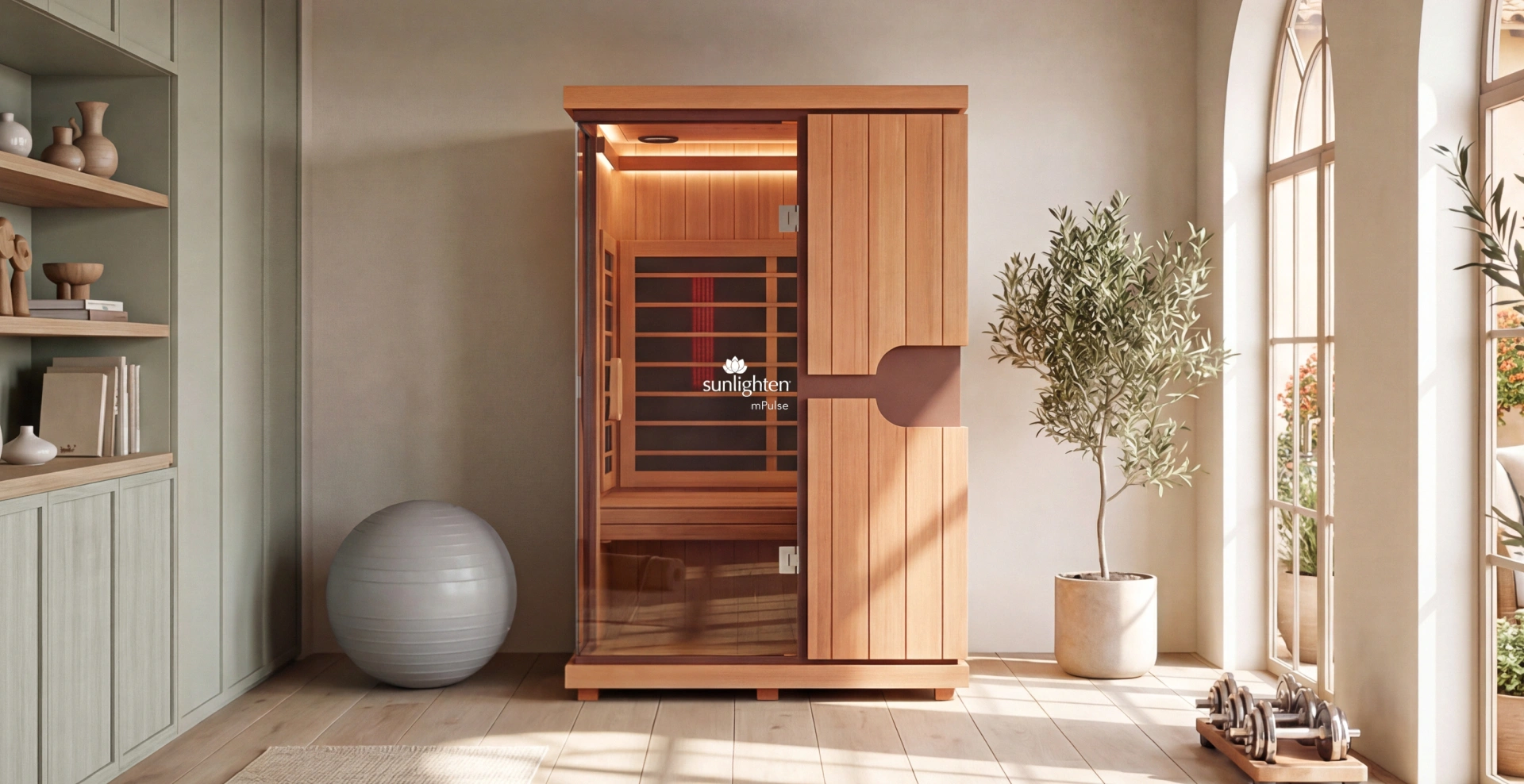
mPulse is built around a single idea: separate the wavelengths, then dose them deliberately. PulseIQ™ delivers far infrared at 9.4 microns, mid infrared at 6.7 microns, near infrared at 880 nanometers, and red light at 650 nanometers as four independently controlled outputs — not one blended emission. Six engineered wellness programs (Heart Health, Detoxification, Muscle Recovery, Relaxation, Weight Loss, Anti-Aging), plus a Customize mode, decide which wavelengths run, at what dose, for how long.

The 2-person Believe carries 6 far-infrared heaters, 5 mid-infrared heaters and 4 red/near-infrared LED elements — the near-infrared and red light are integrated into the cabin at a working distance from the body, not hung on a distant wall as an accessory.

Independent testing backs the two numbers that matter most. Bruker Analytical Services measured SoloCarbon® Custom Spectrum emissivity at 0.99 (March 1, 2022). Vitatech Electromagnetics measured 0.16 mG RMS on the mPulse Believe and 0.66 mG on the mPulse Conquer, recorded November 5, 2020 by electrical engineer Kyle Quinn at Sunlighten's Lenexa, Kansas facility, using a Bartington Mag-03 fluxgate magnetometer — with the readings taken at the torso position of a seated occupant, not at a single heating element (Vitatech report VTE-3200). For reference, Vitatech classifies 1–9.9 mG as "low" and recommends 10 mG as a long-term human exposure limit; the mPulse readings sit an order of magnitude below that.

The honest ledger. mPulse is quote-based, so you cannot price it in a browser tab the way you can price a Fuji — that is a real friction point, and Peak is right to call it out. The mid-infrared band is labeled 6.7 μm, which falls outside the CIE standard's 1.4–3 μm mid-infrared range and would be classified as far infrared under that convention; it reflects Sunlighten's own heater-zone naming and is worth understanding before you compare spec sheets across brands. And Sunlighten's warranty makes the customer responsible for freight on warranty parts.

Choose the mPulse if you can finish the sentence "I want a sauna because ___" — recovery after training, sleep, cardiovascular support, skin — and you'd rather the sauna decide which wavelengths run and for how long than have you guess at a temperature dial. This is the sauna for the person who reads the spec sheet before buying, and who wants a different session on a hard training day than on a bad sleep week.

Choose something else if what you actually want is to get very hot and sit there. That's a legitimate reason to own a sauna, and the programs will feel like overhead — Amplify is built for it and gets hotter.

Learn more: mPulse Infrared Saunas · Infrared Sauna Heaters & SoloCarbon® Technology

Sunlighten Amplify™

Amplify is not a downgraded mPulse. It is a different goal.

Where mPulse separates the wavelengths, Amplify blends full-spectrum infrared on purpose — far, mid and near together — to produce a hotter, more intense session. The Amplify II pairs 4 far-infrared SoloCarbon® heaters with 2 additional 500W full-spectrum heaters and heavier insulation, and is engineered to reach 170°F. The additional wavelengths contribute heat even where they don't fully absorb, which is exactly the point: this is the cabin for someone who wants serious heat, nervous-system regulation, and a deep, sweat-heavy session.

It carries the same SoloCarbon® far-infrared technology and the same 0.99 emissivity measurement as mPulse, and it recorded the lowest EMF reading in the Vitatech report: 0.11 mG RMS.

The newer Amplify RED extends the line by engineering red and near-infrared photobiomodulation directly into the heater and panel placement — addressing proximity and dose by design rather than adding a panel to a cabin.

The honest ledger. Amplify blends its spectrum, so it does not offer mPulse's per-wavelength dosing or programs. Sunlighten does not publish a max-temperature figure for mPulse for direct comparison. And the Amplify II is quote-based like the rest of the cabin line.

Choose the Amplify if you want the hardest, sweatiest session in this comparison and nothing standing between you and the heat — 170°F, the same 99%-emissive far infrared as the mPulse, one set of controls, no decisions to make before you sit down. If your idea of a good sauna is one you have to talk yourself into staying in, this is it.

Choose something else if you'd genuinely use per-wavelength dosing. Amplify blends its output by design, and that isn't a setting you can turn on later — it's the difference between the two products. If you're torn, the honest test is whether you'd rather change the program or change the temperature.

Learn more: Amplify Full-Spectrum Saunas

Clearlight® Sanctuary™ 2

Clearlight is a genuinely credible company with the longest track record of the four. Dr. Raleigh Duncan began the work in 1997, and the doctor-founder story is real, not marketing. The Sanctuary 2 is a well-built cabin: two 500W True Wave™ full-spectrum heaters on the front wall, True Wave® far-infrared heaters on the back wall, side walls, calf area and under the floor, plus a built-in backrest, 12-color chromotherapy and app control. Clearlight states its heaters combine ceramic and carbon and target a 9.4-micron wavelength — the same target band as Sunlighten's far infrared.

Clearlight also has the best warranty in this comparison, and it is the only one that survives reading the fine print. Its residential limited lifetime warranty covers "the entire sauna — heaters, controls, electrical and wood… even the included audio system," with no year cap stated anywhere in its terms (5 years for commercial use). Clearlight calls itself "the only infrared saunas backed by a true limited lifetime residential warranty," and on the evidence of the five sets of terms reviewed here, that phrasing is doing honest work — see the warranty section below. Clearlight also states ETL and CE certification and a 48-point quality-control inspection with dual-level approval.

Where it sits technically is the same blended full-spectrum category as Peak. The wavelengths are not separated and independently dosed.

The honest ledger. Clearlight does not publish the full written warranty terms as a contract-style document the way Sun Home does, so a buyer relying on the lifetime coverage should ask for the complete terms and exclusions in writing before purchase — the absence of a stated cap is not the same as a document confirming there is none. On EMF, Clearlight's published position is that its heaters "cancel out both EMF and ELF," with stated readings of "< 1 mG at the heater surface" and "0–1 mG at the bench," and ELF readings "3–5 times below" a 10 V/m threshold of concern. Those are plausible figures — but as published, they are self-reported: no testing laboratory, test date, instrument or report is named on the pages reviewed. Emissivity is not published. Per-band near- and mid-infrared wavelengths are not published. Red light therapy is not included in the Sanctuary 2 — it is sold as a separate tower add-on, which reintroduces exactly the distance problem an integrated system is designed to solve. Pricing is quote-only. And Clearlight does not disclose where or by whom its saunas are manufactured on the pages reviewed.

The Sanctuary 2 is also the lighter cabin in a like-for-like comparison: 450 lbs, against 541 lbs for the Amplify II and 551 lbs for the mPulse Believe.

Choose the Sanctuary 2 if the warranty is the thing that lets you sign the order. It's the only lifetime term in this comparison that is still a lifetime term after you read the fine print, it comes from the company with the longest track record here, and you can sit in one at a Perspire studio before you decide — which no one else on this list offers.

Choose something else if you want the safety and performance numbers to arrive with a lab, an instrument and a date attached rather than as a company statement — or if you want red light therapy in the sauna itself, not a tower you buy separately and stand in the corner.

Peak Saunas Fuji

Peak does two things better than anyone else in this comparison, and both deserve to be said plainly.

First, they publish a price. $8,250, on the page, no consultation required. Second, they publish irradiance at three distances — 175 mW/cm² at 6", 107 at 12", 80 at 24" — which almost no one in this category does. The Fuji's red light panel is substantial: 9" × 36", 216 dual-chip LEDs, eight wavelengths from 630 nm to 1060 nm, included standard on the front wall. The cabin is well-appointed: touchscreens inside and out, WiFi app, Bluetooth speakers, chromotherapy, oxygen ionization, a foot-reflexology heater, and a company with a 4.76/5 average across 3,900+ verified reviews.

The honest ledger. Peak uses "smart sauna" language, but the delivery is not separated. The Fuji's heating is described as full spectrum across 700–25,000 nm from 8 panels of carbon FAR plus halogen/quartz — a broad blended range, not distinct bands at controlled doses. The red light panel blends eight wavelengths into one output rather than dosing any single one; more wavelengths in a blend is not the same as more control, and the research does not support treating red and near-infrared as interchangeable (Giacci et al., PLOS ONE, 2014).

On EMF, "near-zero EMF" appears in the product name itself, but no reading, no lab and no test date are published on the product page or the trust page. Emissivity is not published.

Two other things a buyer should check. The "limited lifetime" warranty is defined on Peak's own comparison page as 7 years residential on structure, wood and heating elements — the same term as Sunlighten's cabinetry-and-heater coverage. And the red light panel warranty is listed as 1 year on the Fuji product page while the trust page states 7 years; worth asking which applies before purchase.

Peak's longevity claims — "−50% cardiovascular mortality," "−65% Alzheimer's risk," "−40% all-cause mortality" — are drawn from Laukkanen et al., JAMA Internal Medicine, 2015. That is a large, well-regarded prospective cohort, and it is a study of traditional Finnish sauna bathing at roughly 80°C, not of infrared saunas. It is legitimate category evidence. It is not evidence about the Fuji.

Finally, Peak states its saunas are "designed and engineered by Peak Saunas, a US direct-to-consumer sauna company" and "precision-engineered in the USA," but does not disclose who manufactures them or in what country. In a customer review response, Peak indicates it is "not allowed to know the name of the manufacturer" of the red light panel.

Choose the Fuji if you want to buy a sauna this week, at a price you can see on the page, with a full-wall red light panel already in it and no consultation call in between. Peak publishes more red light data than anyone here, and if the red light is the main reason you're buying, that transparency is worth something real.

Choose something else if you intend to sit back against the bench, which is where most people spend a session — Peak's own figures put the panel at 175 mW/cm² at 6 inches and 80 at 24, and the bench is not at 6 inches. Also look elsewhere if you want more heat than 150°F, an EMF reading with a lab behind it, or a company that will tell you who builds its saunas.

Sun Home Eclipse — the heaviest cabin, at a published price

Price: $9,999 (from $10,599), published · Weight: 600 lbs · Exterior: 51.5"W × 47.2"D × 76.7"H · Interior: 42.8" × 42.2" × 71.5" · Electrical: 120V / 2,820W / 23.5A on a dedicated 30A circuit (NEMA L5-30) · Max temperature: 165°F

Sun Home is the newest of the five brands here and, on two measures, the most rigorous.

The Eclipse is the heaviest cabin in this comparison at 600 lbs — more than the mPulse Believe, and 215 lbs more than the Peak Fuji — with 6 far-infrared heaters plus 2 full-spectrum heaters, dual red light towers at 660 nm and 850 nm included, and Magne-Seal panels that assemble without tools. Sun Home publishes its price outright.

Its warranty is marketed as limited lifetime on cabinetry and heaters, with 3 years on controls, 1 year on LED lighting, glass doors and audio — and, genuinely better than anyone else here, parts, labor and all shipping covered at no cost for the first 90 days. But the word "lifetime" is defined in Sun Home's own terms, and it does not mean what most buyers will assume: "The limited lifetime coverage for cabinetry and heaters is applicable for up to seven (7) years, the expected useful lifetime of these components." Seven years is the same term Sunlighten publishes without the lifetime framing — and the same term Sun Home applies to its Equinox and Solstice lines, where it is simply labeled "7 years." After the first 90 days, coverage is parts only; the customer pays shipping and labor.

Sun Home also deserves credit for the most self-critical technical writing in the category. Its own EMF explainer names Vitatech Electromagnetics as its testing lab, publishes a seated-position range of 0.3–0.9 mG RMS at about three feet, and then explicitly warns readers that the widely quoted "0.5 mG" figure "falls within the three-foot range and should not be presented as a universal seated-position or whole-cabin reading." Its emissivity explainer publishes a 99% figure and states in the same breath that the number is manufacturer-published and "has not been independently third-party verified in public documentation." That is unusually honest, and it is the standard this whole category should be held to.

The honest ledger. The Eclipse is a blended full-spectrum cabin — the wavelengths are not separated or independently dosed, and Sun Home does not publish per-band micron figures for its infrared. Emissivity is a manufacturer figure by Sun Home's own admission, where Sunlighten's 0.99 is a Bruker measurement with an instrument, a tester and a date. On EMF, both brands used Vitatech, but the published numbers aren't measured the same way: Sunlighten's 0.11–0.16 mG readings were taken at the torso of a seated occupant, Sun Home's 0.3–0.9 mG at about three feet, and Sun Home notes its own signed report and raw dataset are not public. Sun Home's own product pages also disagree with each other on the Eclipse's wood — the Eclipse overview page says Canadian Red Cedar while the 2-person product page says Canadian Hemlock — and the "<0.5 mG" figure on the overview page is the one the company's own explainer cautions against. It does not disclose who manufactures its saunas or where. And it has no Trustpilot profile, so there is no third-party review record to check against the reviews on its own site.

Its warranty also carries the longest list of conditions of the five: residential use only, original purchaser only (it ends if you sell the sauna), the sauna must be used within a year of its manufacture date, and coverage is voided by using an extension cord or power strip instead of a dedicated outlet, installing it within five feet of any water source including a shower or cold plunge, any modification, improper installation, or insect and rodent damage. Normal wood behavior — minor dents, scratches, grain variation, and cracking from humidity swings — is explicitly excluded as non-defective. None of that is unusual in this category, and Sun Home publishes all of it plainly, which is more than most do. It just means the headline number and the real coverage are different things.

Choose the Eclipse if you judge a sauna by how solid it feels when you close the door. At 600 lbs it's the heaviest cabin in this comparison by a wide margin, the price is published, and the first 90 days of ownership are the best-covered of the five — parts, labor and shipping, all of it, at no cost.

Choose something else if the lifetime warranty is what drew you in — read the cap first. It's seven years, the same term Sunlighten publishes without the lifetime label, and after 90 days you're paying freight and labor like everyone else. Also look elsewhere if you want wavelengths dosed rather than blended, emissivity verified by an outside lab rather than stated by the manufacturer, or a public review record you can check independently.
Read that column again. Four of these five converge on seven years of coverage for the cabinet and the heaters. Two of them call it "lifetime." Sun Home applies both labels to its own products depending on the line — the Eclipse's "limited lifetime" and the Solstice's "7 years" are the same seven years.

Clearlight is the genuine exception, and its marketing language — "the only infrared saunas backed by a true limited lifetime residential warranty" — is pointed directly at this practice. On the terms published as of September 1, 2026, that claim holds up.

Sunlighten's warranty is seven years and we call it seven years. That is not the longest term here; Clearlight's is. What we will not do is print "lifetime" on a term that expires.

Three questions to ask about any sauna warranty:

  1. Is "lifetime" defined in the written terms, and at how many years? Ask for the sentence, not the marketing page.
  2. Who pays labor and freight, and starting when? A covered part in year four can still cost a technician visit and freight both ways. Sun Home covers all three for 90 days; Sunlighten puts freight on the customer from the start; the others don't publish the detail.
  3. Does it transfer, and what voids it? Sun Home's ends if you sell the sauna, and is voided by an extension cord or by installing within five feet of a shower or cold plunge. Every brand has a list. Get it before you buy, not after.
The research each brand can actually point to

There is a meaningful difference between citing the sauna literature and appearing in it.

Studies conducted on Sunlighten equipment:

  • Beever R. "Do Far-Infrared Saunas Have Cardiovascular Benefits in People with Type 2 Diabetes?" Canadian Journal of Diabetes, 2010;34(2):113–118. — 20 adults with type 2 diabetes, 20-minute sessions three times weekly for three months. Systolic blood pressure fell 6.4 mm Hg (124±12 vs. 118±15, 95% CI 0.01–12.71, p=0.05), with a trend toward reduced waist circumference. No adverse events; 75% completion. The infrared device used was provided by Sunlight Saunas Inc. — Sunlighten's earlier name. Small sample, non-randomized, unblinded; the authors say so themselves.
  • Auburn University at Montgomery flexibility study, conducted by Michele Olson, Ph.D., Professor of Exercise Science — 12 participants, randomized crossover, stretching in a typical 70°F training room versus stretching inside an mPulse using mid and far infrared. Hamstring and low-back range of motion improved roughly two to three times more in the sauna: right hamstring +1.95" vs. +0.64"; left hamstring +1.45" vs. +0.74"; seated low-back/hamstring +2.15" vs. +1.0". Small, acute-effect, single-site.
  • Sunlighten Core Temperature Study — internal, single-subject data: core temperature rose almost 3°F across a 30-minute Solo session and stayed elevated for 30 minutes afterward. Illustrative, not evidentiary.

Independent lab testing on Sunlighten hardware: Bruker Analytical Services (emissivity, 3/1/2022) and Vitatech Electromagnetics (EMF, report VTE-3200, tested 11/5/2020).

Clearlight references three studies associated with the brand — Loras College on exercise recovery, Binghamton University on weight loss, and a UCSF trial — but journal, year and sample size were not listed on the pages reviewed.

Peak Saunas cites the general sauna literature, principally Laukkanen 2015 on traditional Finnish sauna bathing. No Fuji-specific or Peak-specific study was identified.

Sun Home publishes a substantial, well-sourced library on the general infrared and heat literature — among the best consumer-facing writing in the category — but no study conducted on Sun Home equipment was identified.

Six questions to ask any sauna company before you buy
  1. What wavelengths do you deliver? In microns and nanometers, per band — not "full spectrum."
  2. Are they separate or blended? And if separate, what controls the selection?
  3. At what dose, and how consistently? Do you control the heater's surface temperature, or only the air temperature?
  4. How close are the emitters to the body? Ask for irradiance at the actual seated distance, not at 6 inches.
  5. What independent testing proves it? Wavelengths, EMF, materials, VOCs and off-gassing — with a lab name and a test date. Ask them to send the report.
  6. Who manufactures it, and where? And who pays freight on a warranty part in year four?
What we still don't know

Being straight about the gaps is part of the point.

  • No head-to-head test exists comparing delivered infrared absorption across these five cabins under identical conditions. Emissivity is a measurement of the heater, not of what a given body absorbs in a given session. Anyone claiming a verified head-to-head absorption win — including us — should be asked for the protocol.
  • Sunlighten does not publish a SoloCarbon® surface-temperature specification or a measured spectral output curve. The surface-temperature-controls-wavelength argument is sound physics, and the engineering intent is real, but the specific number is not in the public record.
  • Competitor heater cycling behavior has not been independently tested. The thermostat-drift description is a mechanism, not a measured finding about a named competitor's product.
  • Clearlight's, Peak's and Sun Home's EMF figures may well be accurate. The criticism here is about published verification and measurement basis, not about the underlying numbers. Sunlighten and Sun Home both used Vitatech; neither company's full signed report is public, and the two published figures were taken at different distances, so they are not directly comparable.
  • Review scores are a snapshot, not a verdict. Trustpilot counts and scores move weekly, brands differ in how long they've collected reviews and how actively they solicit them, and the absence of a profile is not evidence of bad service.
  • Prices and specs change. Everything here reflects pages as published on September 1, 2026.
The bottom line

If you want intelligent, targeted delivery — specific wavelengths, at a specific dose, for a specific goal — mPulse is the sauna in this comparison built for that. If you want Sunlighten's highest-absorbed far infrared in the most intense heat experience available, Amplify is built for that. Both come with the same independently tested emissivity and EMF numbers, the same disclosed manufacturing process, and the same research base.

Clearlight offers the longest track record and the only warranty here that is still a lifetime warranty after you read the terms. Peak offers published pricing and a large included red light panel with published irradiance. Sun Home offers the heaviest cabin, the best first-90-days service terms, and the most candid technical writing in the category. All three are real companies making real saunas, and on the criteria they lead, they lead.

The difference is what happens when you ask for the report.

Sources
  1. Bruker Analytical Services. Heater emissivity comparison test, March 1, 2022. Testing by Peng Wang, Ph.D., Bruker Optics. Vertex 70 FTIR spectrometer, Harrick Auto Seagull accessory, 45° incidence. (Sunlighten commissioned; independently performed and signed.)
  2. Vitatech Electromagnetics, LLC. "Sunlighten Sauna EMI Test," document VTE-3200. Testing performed November 5, 2020 by Kyle Quinn; final submission January 5, 2021. Bartington Mag-03 fluxgate magnetometer; NARDA EHP-50f.
  3. Beever R. "Do Far-Infrared Saunas Have Cardiovascular Benefits in People with Type 2 Diabetes?" Canadian Journal of Diabetes. 2010;34(2):113–118. Canadian Journal of Diabetes
  4. Olson M. "A Study of Changes in Flexibility with mPulse 3-in-1 Full Spectrum Infrared Sauna Therapy." Auburn University at Montgomery.
  5. Vatansever F, Hamblin MR. "Far infrared radiation (FIR): its biological effects and medical applications." Photonics & Lasers in Medicine. 2012. PMC
  6. Imamura M, et al. "Repeated thermal therapy improves impaired vascular endothelial function." J Am Coll Cardiol. 2001. PubMed
  7. Janssen CW, et al. "Whole-Body Hyperthermia for the Treatment of Major Depressive Disorder." JAMA Psychiatry. 2016. PubMed
  8. Laukkanen T, Khan H, Zaccardi F, Laukkanen JA. "Association Between Sauna Bathing and Fatal Cardiovascular and All-Cause Mortality Events." JAMA Internal Medicine. 2015;175(4):542–548. JAMA Network — traditional Finnish sauna cohort.
  9. Giacci MK, et al. "Differential effects of 670 and 830 nm red near-infrared irradiation therapy." PLOS ONE. 2014. Link
  10. US Patent 8,737,827 — "Sauna heating element with high emissivity coating." Google Patents
  11. Sunlighten. Patents & Design Registrations; Quality & Craftsmanship; Warranty; Amplify; mPulse Infrared Saunas; Sauna Heaters. Accessed September 1, 2026.
  12. Peak Saunas. Fuji 2-Person product page; Compare page; Why Trust Peak Saunas; About Us. Accessed September 1, 2026.
  13. Clearlight Infrared Saunas. Sanctuary 2 product page; Sanctuary Full Spectrum collection; Our Founder; "Infrared Sauna Safety 101: Low EMF and ELF Saunas." Accessed September 1, 2026.
  14. Sun Home Saunas. Eclipse overview page; Eclipse 2-Person product page; Warranty Information (terms for orders placed on or after March 2, 2026); "Which Infrared Sauna Brand Is Actually Low EMF? (2026)"; "Low EMF Infrared Sauna: High Emissivity Explained (2026)." Accessed September 1, 2026.
  15. Clearlight Infrared Saunas. Warranty Information. Accessed September 1, 2026.
  16. Trustpilot. Company profiles for Sunlighten, Inc., Clearlight Infrared Saunas and Peak Saunas. Scores and review counts read September 1, 2026.