Written by: Bri Partridge
Verified by:
Fact Checked by:
Published on: Oct. 16, 2026
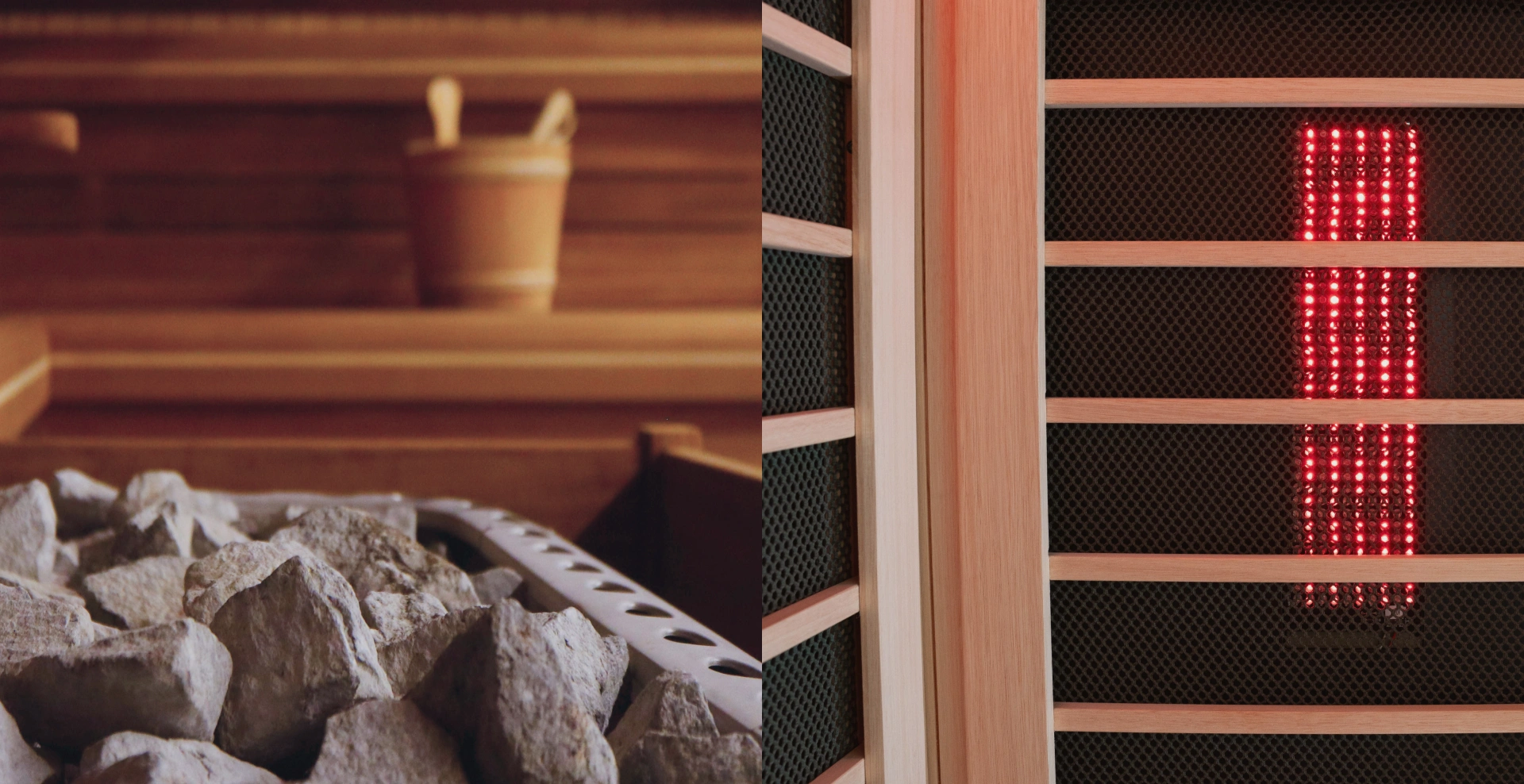
A Buyer's Guide to Heat, Size, and Features
How Do You Choose a Home Sauna?
With so many models and features available, it’s easy to focus on specifications before deciding what matters most. A sauna with advanced technology may appeal to one buyer, while another may prioritize a simple, comfortable place to unwind. A practical buying process begins with your intended experience and works outward to the details.
Should You Choose an Infrared or Traditional Sauna?
The first major decision is the type of heat you want, and the two options are further apart than they sound.
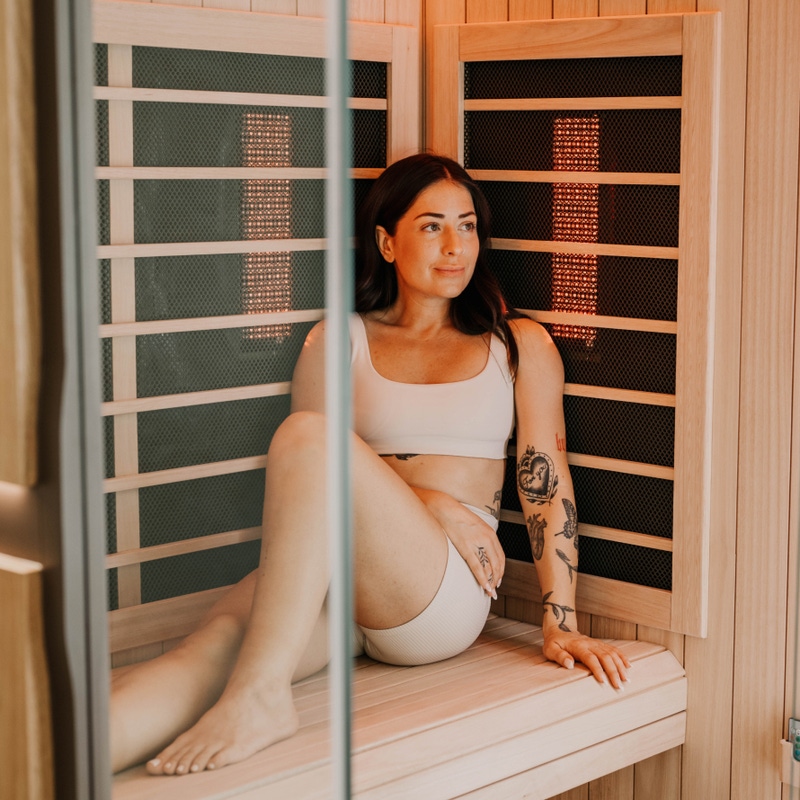
Infrared
| Air temperature | 100–150°F (110–130°F typical) |
| Humidity | ~25–35% |
| How heat reaches you | Infrared radiation absorbed directly by tissue |

Traditional dry
| Air temperature | 160–200°F |
| Humidity | 10–20% |
| How heat reaches you | Heated air, by convection, against the skin |

Steam room
| Air temperature | 110–120°F |
| Humidity | ~100% |
| How heat reaches you | Saturated water vapor condensing on the skin |
Infrared range per Sunlighten’s published operating guidance: 100–150°F overall, 100–129°F for beginners, and a 130°F practical ceiling for routine use (First Timer’s Guide).
Traditional saunas use heaters to warm the surrounding air and surfaces, typically creating a high-temperature environment. Some include stones that allow controlled water use to temporarily increase humidity.
Infrared saunas use radiant energy to warm the body more directly. Because they don’t rely on raising air temperature to carry heat to your skin, they produce a comparable warming response at a much lower ambient temperature. The 60-degree gap in the table isn’t a compromise — it’s a consequence of how the heat is delivered.
Both can produce a warming, sweat-inducing experience, but they feel different. Someone who enjoys intense heat and the classic Finnish sauna atmosphere may prefer a traditional model. Someone who wants radiant warmth, lower air temperatures and adjustable settings may find infrared more appealing.
Sunlighten specializes in infrared, with models offering far-infrared or full-spectrum configurations, and has been engineering infrared heaters for more than 25 years across 37 patents.
Learn more: Infrared Sauna, Traditional Sauna, or Steam Room: Which One Should You Choose?
What Is the Difference Between Far-Infrared and Full-Spectrum Saunas?
Infrared energy spans different wavelength ranges, commonly described as near-, mid- and far-infrared. Far-infrared is the foundation of most infrared cabins. Full-spectrum systems add near- and mid-infrared alongside it, although the exact design and output vary considerably by manufacturer.
That variation is the reason to ask a harder question than “how many wavelengths?” Two cabins set to the same temperature for the same duration can deliver materially different doses, because what reaches your body is governed by the heater’s surface temperature (which sets the wavelength), its emissivity (how much energy is emitted as usable infrared rather than reflected), and whether delivery stays constant across the session or drifts as the heater cycles.
Emissivity is measurable, and Sunlighten publishes the measurement. Independent testing by Bruker Analytical Services measured SoloCarbon® at 0.95 and SoloCarbon® Custom Spectrum at 0.99, against 0.93 for a conventional carbon surround heater — using a Vertex 70 FTIR spectrometer at 45° incidence, tested by Peng Wang, Ph.D., on March 1, 2022 (full test report).
Heater configuration is published per model, and it is the clearest signal of what a cabin is built to do. An Amplify II pairs 5 patented SoloCarbon® far-infrared heaters with 3 full-spectrum high-intensity heaters, which is what takes it to 170°F. A Signature I runs 8 far-infrared heaters and no full-spectrum, which is why it sits in the standard infrared range.
On mPulse®, the wavelengths are delivered independently rather than blended. PulseIQ™ separates far infrared at 9.4 microns, mid infrared at 6.7 microns, near infrared at 880 nanometers and red light at 650 nanometers, so each can be dosed on its own terms rather than averaged together.
More is not automatically better, and this is worth understanding before you compare spec sheets. Light energy follows a biphasic dose response: beyond a certain point, additional energy does not produce additional benefit. Intensity also falls with the square of the distance from the source, which means placement determines how much actually reaches you. A cabin with more emitters in the wrong positions can deliver less usable dose than one engineered around where the body sits.
Research on sauna and light therapy is still developing, and claims about specific outcomes require evidence appropriate to the technology and intended use. When comparing heating technologies, ask what the system actually delivers, whether the manufacturer publishes a measurement for it, and how much control you have over the session.
How Many People Will Use Your Sauna?
Sauna capacity affects the cabin’s dimensions, seating layout, purchase price and electrical requirements.
A one-person sauna may be ideal for someone who usually enjoys sessions alone and wants to minimize the footprint. Two-person saunas allow shared sessions and give a single user more room. Larger cabins accommodate families, but require more floor area and often a more involved installation.
Don’t rely on advertised capacity alone. Compare actual bench dimensions, interior height and legroom. A sauna marketed for two can feel generous for one person and close-fitting for two adults.
Here is how three Sunlighten models compare on the measurements that decide whether one fits (models vary in capacity options):
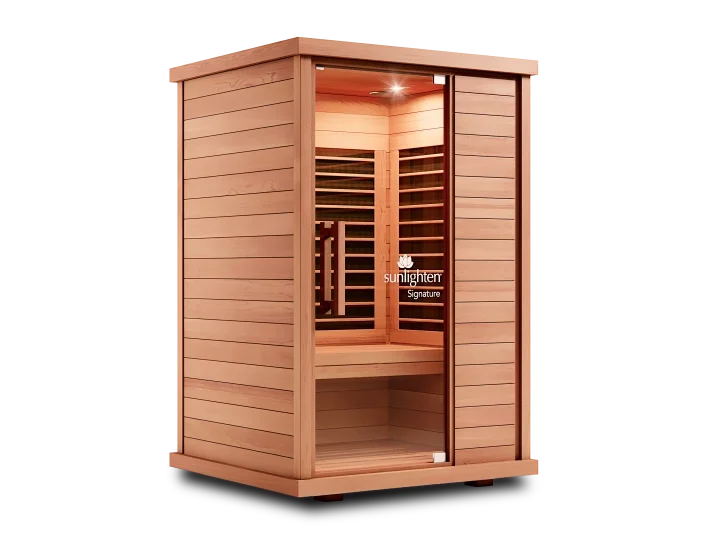
Signature I
| Capacity | 1 person |
| Exterior (W x D x H) | 37.8" x 39.8" x 77.7" |
| Interior (W x D x H) | 32.2" x 33.6" x 70.3" |
| Heaters | 8 far infrared |
| Weight | 428 lbs |
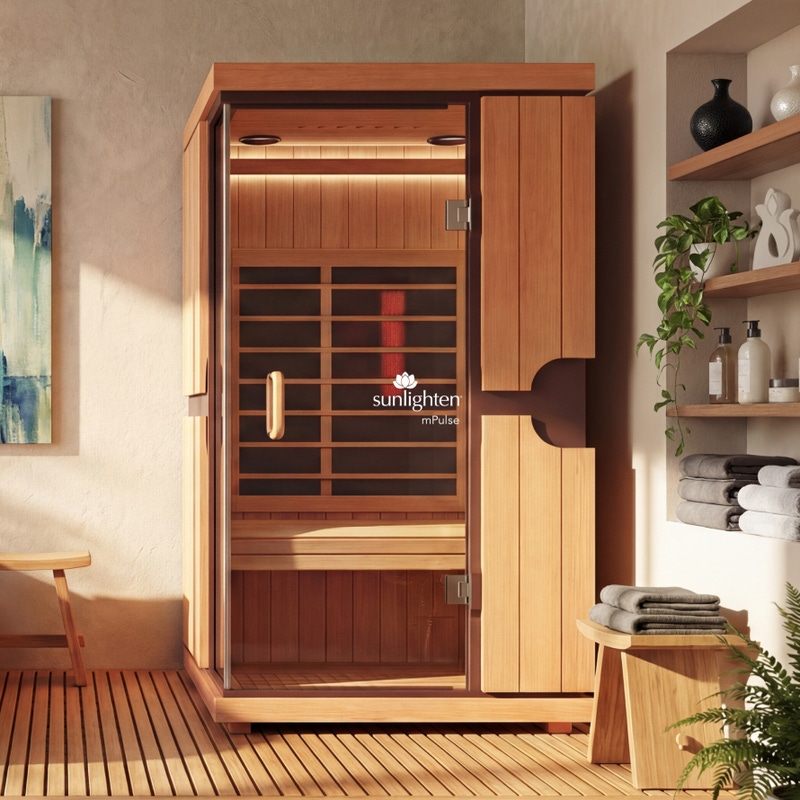
mPulse Aspire
| Capacity | 1 person |
| Exterior (W x D x H) | 43.6" x 41.6" x 79" |
| Interior (W x D x H) | 37.8" x 35.6" x 71.5" |
| Heaters | 5 far, 4 mid, 3 near/red LED |
| Weight | 432 lbs basswood / 463 lbs eucalyptus |
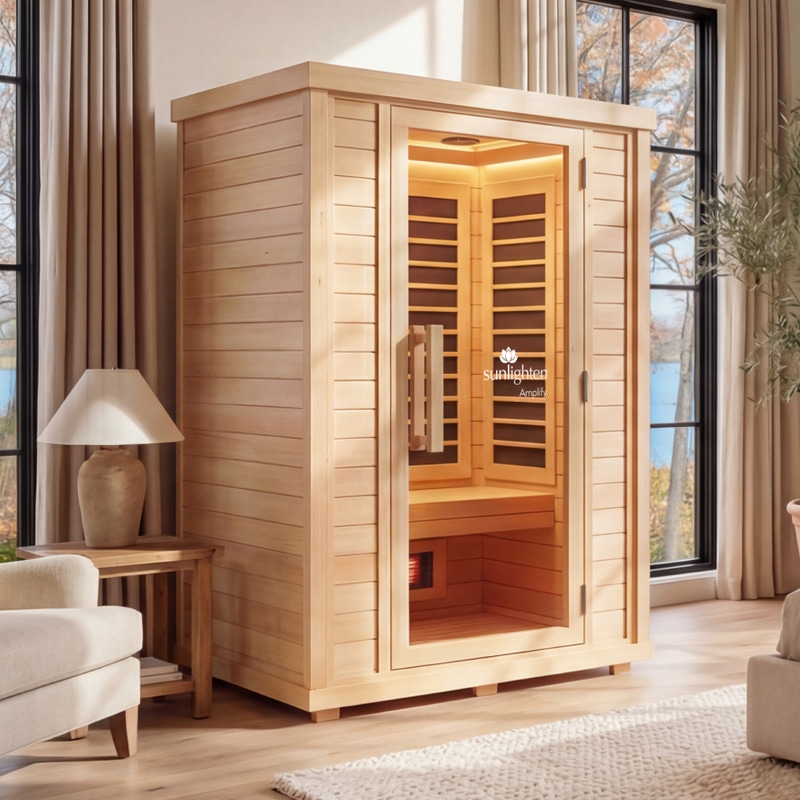
Amplify II
| Capacity | 2 people |
| Exterior (W x D x H) | 50.9" x 45.9" x 77.7" |
| Interior (W x D x H) | 45.4" x 39.9" x 70.3" |
| Heaters | 5 far infrared, 3 full-spectrum |
| Weight | 529 lbs basswood / 562 lbs eucalyptus |
Exterior heights include the 2-inch feet. Specifications from Sunlighten’s published spec sheets (Doc# 09142026); every model has its own sheet on the guides and specs page.
Learn more: Infrared Sauna for One Person: Choosing Size, Features, and Placement
How Much Space Do You Need?
Before selecting a model, measure the intended installation area. Record available floor width, depth and ceiling height, then compare those measurements against the sauna’s external dimensions and required clearances.
Ceiling height deserves particular attention, and it is where most rooms fail. Sunlighten cabins run 77.7 to 79 inches tall including feet, and the recommended overhead clearance adds another 6 to 12 inches on top, so a room needs roughly 7.5 feet of usable height. Measure the lowest point rather than the room’s maximum: a sloped ceiling, soffit, beam or light fixture can rule out a model that fits the floor plan comfortably.
Clearance is published, so you can plan against a real number rather than a guess. Sunlighten recommends 4 inches between the cabin and surrounding walls on every model, and 12 inches above it (6 inches on mPulse Aspire). The side clearance allows outlet access; the overhead space is needed for assembly connections and air circulation. Add those figures to the footprint before deciding the room works.
The equipment also needs room for its door to open and access for maintenance. Delivery and assembly matter too. Sunlighten ships cabins as flat panels rather than assembled units, and the cartons are large: an Amplify II wall carton measures 14" x 51" x 76". Measure doorways, hallways and stair turns along the whole delivery route.
Weight is the detail most often missed. Assembled cabins run from 428 pounds for a Signature I to 562 pounds for an Amplify II in eucalyptus, worth confirming against the floor structure before an upstairs installation.
Some households may prefer a portable or modular infrared system rather than an enclosed cabin. Sunlighten’s Solo System is one example — a compact design intended for small spaces, with components that nest for storage.
Learn more: How Much Space Do You Need for a Home Sauna? A Room-Planning Checklist
What Electrical Requirements Should You Check?
Electrical specifications should be reviewed before purchase, not after delivery. This is the single most common source of unexpected cost in a sauna project.
Requirements vary by collection, and by model within a collection, so this is one specification that has to be checked against the exact cabin you are buying rather than the range it belongs to.
Signature®
| Capacity | 1–2 people |
| Red light therapy | No |
| Infrared | Far |
| Electrical | 120V |

mPulse®
| Capacity | 1–5 people |
| Red light therapy | Yes |
| Infrared | Near, mid and far delivered separately with PulseIQ™ |
| Electrical | 120V or 240V, differs by model |

Amplify™
| Capacity | 2–4 people |
| Red light therapy | No |
| Infrared | Full spectrum |
| Electrical | 120V or 240V, differs by model |
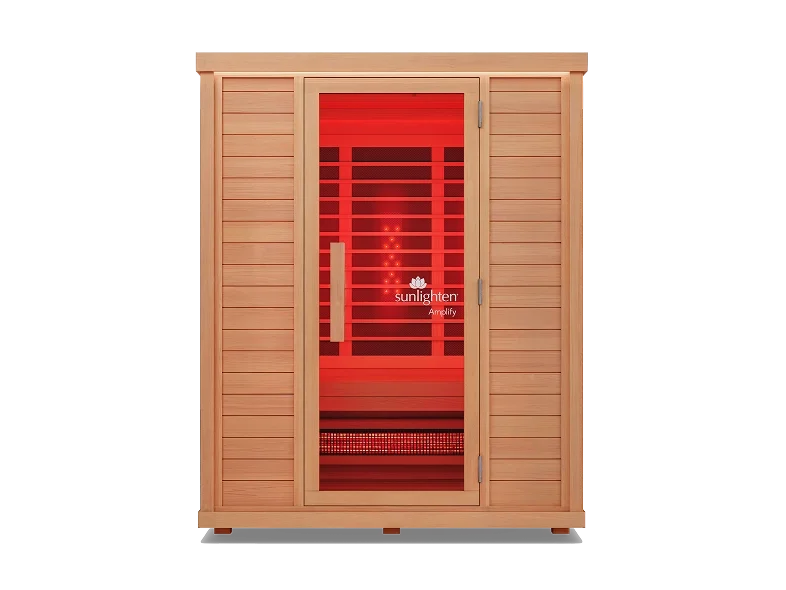
Amplify RED
| Capacity | 2–4 people |
| Red light therapy | Yes |
| Infrared | Full spectrum plus integrated red and near-infrared |
| Electrical | 240V |
Larger cabins, and the Amplify RED collection throughout, require 240V service. That difference is worth establishing early: a dedicated 120V circuit is ordinary residential work, while adding 240V service can be a larger job depending on your panel. Either way, a dedicated circuit is a circuit of its own rather than simply a free outlet.
The power cord is 10 feet and exits from the back left of the roof as you face the sauna, which affects where the cabin can sit relative to the outlet. Plug it directly into the wall: not a power strip, extension cord or converter.
Check the exact model’s voltage, amperage, plug configuration and circuit specification on its spec sheet. Every Sunlighten model publishes one on the guides and specs page. If you’re unsure whether your home can support the equipment, consult a licensed electrician before ordering.
Don’t assume an available outlet is appropriate simply because the plug appears to fit. Follow the manufacturer’s installation instructions, and avoid extension cords or power strips unless specifically permitted.
Electrical upgrades affect the total cost of the project, so include them in your budget from the beginning. A model that appears affordable can become less attractive once a new circuit is priced in.
What Features Are Worth Paying For?
Home saunas range from simple cabins to systems with programmed sessions and integrated entertainment.
Basic features to compare include temperature adjustment, session timers, intuitive controls and comfortable seating. Beyond that, some infrared models offer integrated audio, lighting, touchscreen interfaces or preset wellness programs.
Sunlighten’s mPulse line is built around seven programs, each engineered separately rather than being the same heat cycle under different labels. Heart Health is the most intense, running 45 minutes: it starts hot to raise heart rate and cardiac output, then lowers to sustain it. Detoxification and Weight Loss both run high, built around core-temperature elevation and circulation. Muscle Recovery and Relaxation sit in the middle, with Muscle Recovery using the wavelengths differently to address inflammation and pain. Anti-Aging is deliberately the gentlest, because skin responds better to less heat. A Customize setting lets you set wavelength and duration yourself.
That difference matters more than the program count. The right session for recovery is not the right session for skin, and a single heat cycle applied to both is a compromise in each direction.
The hardware reflects it. An mPulse Aspire carries 5 far-infrared, 4 mid-infrared and 3 near-infrared and red LED panels: four wavelengths under independent control, with an in-sauna tablet and app control for remote start and scheduling. A Signature I runs 8 far-infrared heaters with a programmable timer, a simpler proposition and a lighter electrical draw at 1350W against 2160W.
These features can make the experience more personalized, but their value depends on whether you’ll use them. Someone who prefers quiet sessions may not need built-in audio. Consider how easy the controls are to operate, and whether the settings make sense without repeatedly consulting a manual.
How Important Are Materials and Construction?
A sauna is a substantial piece of home equipment, so construction quality deserves attention — and more importantly, so does what the manufacturer is willing to tell you about it.
Review the materials used for the cabin, bench, door and heating system. Wood selection affects appearance, scent, durability and maintenance, and different finishes respond differently to repeated heat exposure. Sunlighten cabins are built in basswood or eucalyptus, with heater covers in mineral-infused CELLIANT® fabric that acts as an additional infrared layer.
When comparing manufacturers, look for documented specifics rather than broad claims such as premium or medical-grade. Two questions separate brands quickly: where is this built, and what testing happens before it ships? Sunlighten manufactures in its own facility in Vietnam and tests the electrical systems and EMF of every unit before shipping. Many manufacturers in this category publish neither.
If you’re concerned about emissions from materials, request the relevant testing documentation and ask what standards were used. A manufacturer that has done the testing can send you the report.
Also consider practical details: are the benches comfortable, can interior surfaces be cleaned easily, are replacement components available?
Should You Consider EMF and Electrical Safety?
All electrical equipment produces electromagnetic fields. The strength depends on design, current, distance and measurement conditions — which is exactly why a bare “low EMF” label on a product page tells you almost nothing.
Four questions separate a real measurement from a marketing phrase:
- Which measurements were taken, and what figure resulted?
- At what distance from the heater?
- Under what operating conditions?
- Was the testing performed independently, and is the report available to read?
Sunlighten answers all four. EMF measures less than 1 mG, tested by Vitatech Electromagnetics, and the complete report is published as a downloadable PDF rather than summarized into a claim. You can read the measurements, the distances and the conditions yourself.
That last part is the differentiator worth understanding as a buyer. Across this category, some manufacturers publish a number with no lab, method or date attached. Others name a lab but keep the signed report and raw dataset private. Others offer a report that names no instrument or test date. When you ask for the document, the responses tell you a great deal.
Electrical safety certification and proper installation are separate considerations and shouldn’t be overlooked. EMF marketing language doesn’t replace compliant components, suitable wiring and manufacturer-approved installation. For home use, clear safety documentation and reliable service support are part of the purchasing decision.
How Much Does a Home Sauna Cost to Own?
The purchase price is only one component. Others include delivery, assembly, electrical installation, accessories, maintenance and electricity.
Operating cost is more modest than most buyers expect, and it’s straightforward to calculate. Sunlighten’s video Are Saunas Energy Efficient? works through an example using a one-person Signature sauna: a power rating of approximately 1.35 kilowatts over a 90-minute operating period, at an illustrative rate of $0.16 per kilowatt-hour.
1.35 kW × 1.5 hours = 2.03 kWh, at $0.16 = about $0.32 per session.
Actual costs vary with model, local utility rates, preheat time and session length, so the example shouldn’t be applied automatically to other models. For a complete budget, request current specifications and identify any installation work required before ordering.
A sauna with a lower purchase price isn’t necessarily the least expensive over time if it requires electrical modifications or carries limited warranty support.
What Should You Look for in a Sauna Warranty?
A warranty matters for equipment intended for years of repeated home use, and the headline term is rarely the whole story.
Review length and scope together, because different components usually carry different terms. Sunlighten’s residential coverage runs 7 years on cabinetry and heaters, 3 years on controls, and 1 year on glass and audio components.
Then read the exclusions. Find out whether replacement parts, labor and freight are included, whether coverage transfers if you sell your home, and whether registration or specific operating conditions are required to keep it valid. A “lifetime” headline can carry a year cap further down the page, and a long term can exclude the labor needed to use it.
Service availability matters as much as paperwork. Ask how repairs are handled, whether technical support is available, and what happens if a component fails outside the original term.
Compare the actual written warranty documents rather than promotional summaries.
How Can You Choose a Sauna You’ll Actually Use?
A home sauna is most valuable when it fits comfortably into your routine.
Think about when you expect to use it. A short evening session after work? A weekend ritual? A way to unwind after exercise, once you’ve cooled down and rehydrated? The answer influences type, location and features more than any specification does.
A model with sophisticated programs won’t be more enjoyable than a simpler one if you rarely use those programs. A compact sauna may be the better choice if it fits naturally into your home and a larger cabin would not.
Consider the whole experience, from preheating and entering the cabin to cooling down and cleaning afterward. The best sauna isn’t the hottest or the most expensive. It’s the one you’ll return to.
Making Your Final Home Sauna Decision
Choosing becomes easier when you compare in a consistent order:
- Identify your preferred heating experience — infrared or traditional.
- Decide how many people will use it and where it will be installed.
- Verify electrical requirements against your home’s actual capacity.
- Compare heating technology, asking what each manufacturer publishes and measures.
- Evaluate total cost of ownership, including installation and operating cost.
- Review construction, safety documentation, warranty terms and support.
Sunlighten offers infrared sauna systems across a range of sizes, heating technologies and customization options.
Explore Sunlighten infrared saunas
A thoughtful buying decision should leave you confident not only that the sauna will fit your home, but that it will provide the kind of experience you want to return to.
Sources cited
- Bruker Analytical Services. Emissivity testing of SoloCarbon® heaters, March 1, 2022. Vertex 70 FTIR spectrometer at 45° incidence; testing by Peng Wang, Ph.D. Full report (PDF) — source for 0.95 (SoloCarbon), 0.99 (Custom Spectrum) and 0.93 (conventional carbon surround).
- Vitatech Electromagnetics. Low EMF test results for Sunlighten saunas. Full report (PDF) — source for the less-than-1 mG figure.
- Sunlighten. Are Saunas Energy Efficient? — source for the 1.35 kW rating, 90-minute operating period and $0.16/kWh illustrative calculation.
- Sunlighten product spec sheets, Doc# 09142026 — Signature I, mPulse Aspire and Amplify II. Source for all dimensions, interior measurements, heater configurations, electrical requirements, NEMA outlet specification, clearances, carton sizes and weights. Guides and specs
- Sunlighten published operating guidance — source for the 100–150°F range, 100–129°F beginner range and 130°F practical ceiling. First Timer’s Guide to Sitting in a Sauna