Written by: Kate Korom
Published on: Nov. 2, 2026
Which Fits My Routine?
Infrared Sauna vs. Steam Room for Relaxation and Recovery
How Each One Heats You
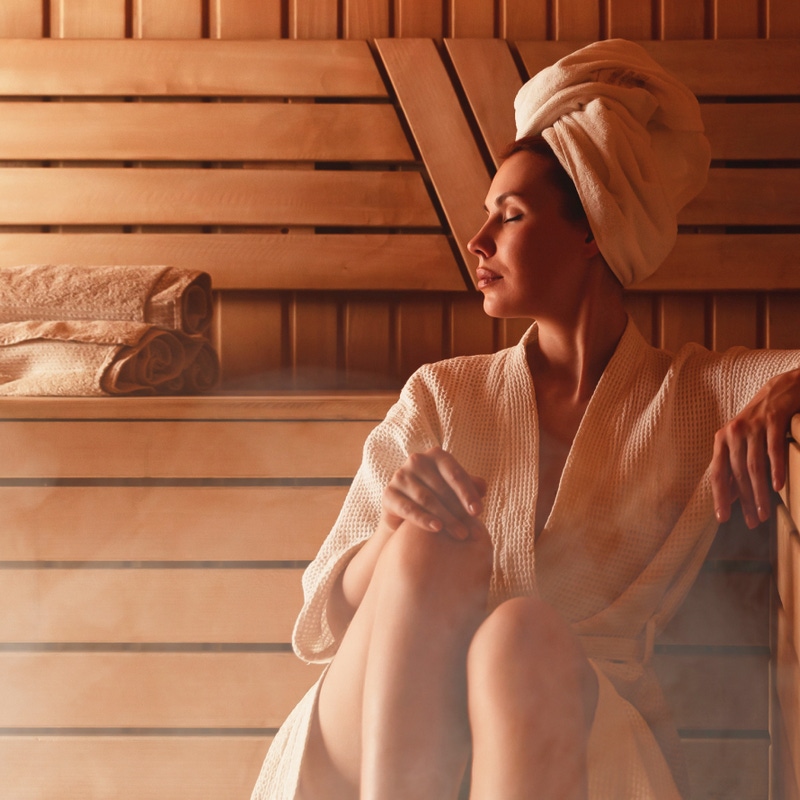
A steam room typically runs at about 110–120°F (43–49°C) at or near 100% relative humidity. That sits within the 40–50°C range reported in a 2026 News-Medical summary of reviews by Laukkanen and colleagues. A steam generator pipes water vapor into a sealed enclosure. The saturated air carries heat to you.
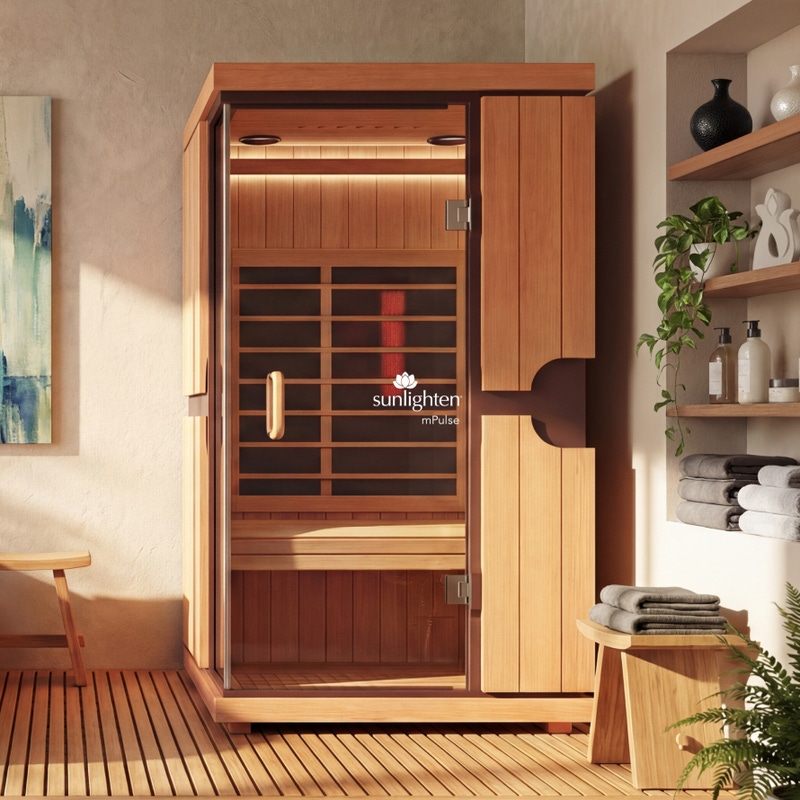
An infrared sauna warms your body directly with infrared energy, as Mayo Clinic staff describe (2024). The cabin air warms too, but it stays far cooler than in a traditional sauna. Infrared saunas generally run about 100–150°F. Sunlighten recommends 100–130°F, starting near 100°F while you acclimate (Sunlighten first-timer guide, 2026); the Amplify RED owner's manual lists an optimal cabin range of 100.4–129°F.
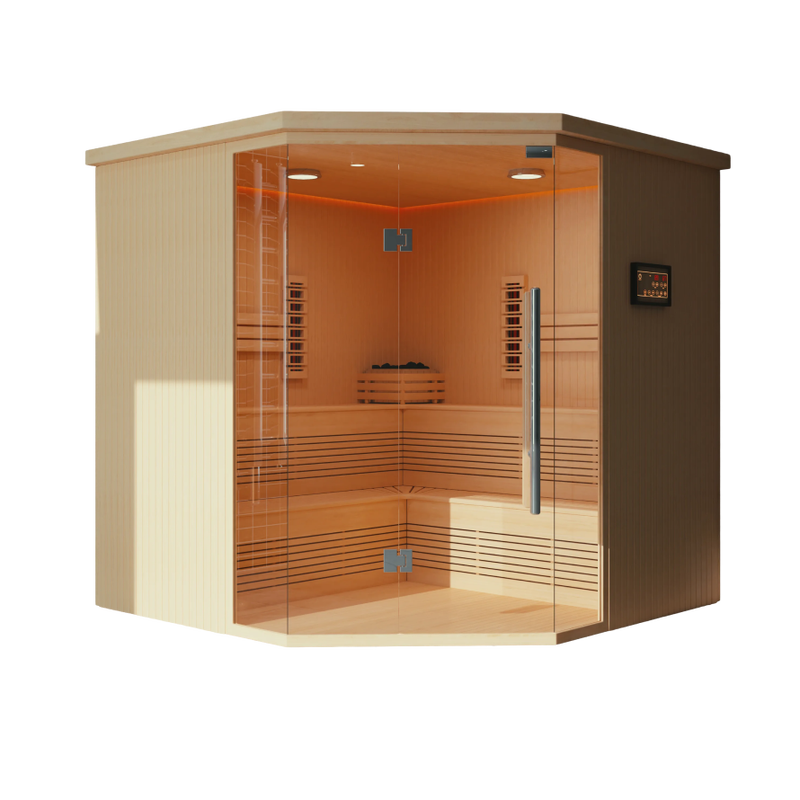
For reference, a traditional Finnish sauna runs at 80–100°C (176–212°F) with 10–20% humidity. That comes from a 2018 Mayo Clinic Proceedings review by Laukkanen, Laukkanen, and Kunutsor.
Why Humid Heat Feels Hotter at Lower Temperatures
Your body cools itself mainly by evaporating sweat. In saturated air, sweat can't evaporate well, so that cooling slows down, and you feel hotter.
A 2026 study in Temperature measured this in 50 healthy adults during Finnish (traditional) sauna sessions. Lead author Iida Laatikainen-Raussi and colleagues found temperature and humidity each raised heart rate independently. Every 1% rise in relative humidity added about 0.37 beats per minute. Every 1°C rise added about 1.40 beats per minute. Humidity also independently raised core body temperature.
Steam saunas add a second effect. When the air is wet enough, vapor condenses on your skin — and water releases heat as it condenses, so the steam is actively warming you on contact, not just surrounding you. That's why a 115°F steam room can feel more intense than a 130°F infrared sauna. Much of the "sweat" on your skin in a steam room is condensed steam.
The same 2026 study tried to measure how much of that condensation effect showed up in the body's response. It was only weakly linked to heart rate, and showed no significant link to core temperature. Condensation clearly shapes how steam feels. Its share of measured strain is less clear.
What this means for your routine: dry air lets your sweat do its job. So infrared sessions can run longer at a comfortable intensity, building toward 30–40 minutes (Sunlighten first-timer guide, 2026). Steam sessions tend to be shorter and feel more intense.
What the Research Says About Recovery and Relaxation
Recovery
Heat changes how your blood moves. Blood flow to your skin climbs from roughly 300 milliliters a minute at rest to as much as 7.5 liters a minute under heat — around half of everything your heart is pumping, according to a 2010 review by Crandall and González-Alonso.6 Whether that shift speeds muscle repair hasn't been tested directly. Several small trials have measured performance after infrared sessions instead.
- Ahokas et al. (2023, Biology of Sport). University of Jyväskylä researchers tested 16 male basketball players.7 After a hard strength and plyometric workout, players had 20 minutes of infrared sauna at about 43°C or 20 minutes of rest. Fourteen hours later, the sauna group lost less jump performance. They also reported less soreness and better perceived recovery. Night-time heart rate and heart rate variability didn't differ.
- Mero et al. (2015, SpringerPlus). Thirty-minute infrared sessions at 35–50°C after training led to better countermovement-jump recovery than no sauna.8
- Noponen, Häkkinen, and Mero (2015, Journal of Athletic Enhancement). Ten national-level male power athletes completed a five-day intensive training block.9 In one block, they used a far-infrared heat bag at 50°C for 40 minutes each evening. Wingate peak power improved with the heat and not without it. The study used a heat bag, not a sauna cabin, and the bag's manufacturer funded it.
All three studies were small and male-only. We found no comparable controlled trial of steam rooms for post-exercise recovery.
Flexibility is a related, separate question. A study at Auburn University at Montgomery, led by exercise science professor Michele Olson, PhD, tested 12 people.10 Each did 20 minutes of rest and 10 minutes of hamstring and low-back stretches. They did this once in a Sunlighten mPulse and once in a 70°F room. Range-of-motion gains were two to three times larger in the sauna. Seated reach, for example, improved 2.15 inches in the sauna versus 1.0 inch in the room. Sunlighten sponsored the study, and it was not peer-reviewed. It measured flexibility right after one session, not recovery from training.
What this means for your routine: use the sauna time actively. Gentle stretching during the session is how the Auburn protocol worked. It fits naturally into a post-workout cool-down.
Relaxation
Heat first stresses your nervous system, then helps it settle. During a session, your body shifts toward sympathetic ("fight or flight") activity as it works to shed heat. A 2018 Applied Physiology, Nutrition, and Metabolism study by Leicht and colleagues showed this in six trained male cyclists.11 A 30-minute sauna at 87°C raised heart rate about 32% from the first 10 minutes to the last. A key marker of parasympathetic ("rest and digest") activity dropped about 62%. The Ahokas infrared trial found the same pattern: higher heart rate and lower heart rate variability during the session than during passive rest.7
The calming effect shows up after you step out. A 2019 Complementary Therapies in Medicine study by Tanjaniina Laukkanen and colleagues tested 93 adults with cardiovascular risk factors.12 Each completed one 30-minute traditional sauna session at 73°C. During a 30-minute cool-down, heart rate variability shifted toward parasympathetic dominance. Resting heart rate fell from 77 beats per minute before the sauna to 68 after recovery. The study had no control group.
Repeated infrared sessions may strengthen that shift over time. A 2011 Journal of Cardiology trial by Kuwahata and colleagues randomized 54 patients with chronic heart failure.13 The treatment group used a 60°C far-infrared dry sauna for 15 minutes, then rested 30 minutes under a blanket. They did this five days a week for four weeks. Their parasympathetic markers rose and sympathetic markers fell. The control group's markers didn't change. These were heart failure patients, not healthy adults.
A 2005 Psychosomatic Medicine trial by Masuda and colleagues used the same 15-minute, 60°C far-infrared protocol in 28 mildly depressed inpatients.14 Relaxation scores improved significantly compared with the control group. This was also a small clinical group.
The 2018 Laukkanen review describes sauna bathing as relaxing and stress-reducing.4 It cites no study for that point, and it covers traditional Finnish saunas only. We found no controlled trial of steam rooms for relaxation, and no study of how steam affects heart rate variability.
What this means for your routine: the wind-down happens mostly after the heat, not during it. Give yourself 20–30 minutes of quiet afterward to cool down. The studies that measured the calming shift all built in a 30-minute rest.12–14
Breathing and Skin: Two Common Steam Claims
Many people choose steam believing it is beneficial for their respiratory system and their sinuses. A 2017 Cochrane review by Singh and colleagues pooled 6 trials and 387 participants.15 It found neither benefit nor harm from heated, humidified air for the common cold. Evidence certainty was low, and the trials used a nasal device, not a steam room.
Many people also assume dry heat dries out skin. A 2008 Dermatology study by Kowatzki and colleagues compared 41 adults.16 Regular Finnish dry-sauna users had more moisture in the outer layer of their skin than non-users. Their skin barrier also recovered faster after a session.
Match the Heat to Your Routine
Your goal usually points you toward one format or the other. Here's how the common ones break down.
Recovering after strength training: infrared sauna. It's the only one of the two with controlled post-exercise trials behind it.7–9 Start with 20–30 minutes after training, and add gentle stretching while you're in the cabin.10
Winding down in the evening: infrared sauna. Dry, moderate heat supports a longer, calmer session, and "rest and digest" activity rises during the cool-down afterward.12 Build from 10–15 minutes at 100°F toward 30–40 minutes,3 then give yourself 20–30 quiet minutes once you step out.
Short, intense heat: steam room. Humidity raises heart rate and core temperature on its own, so the strain builds quickly.5 Keep the session short, and leave right away if you feel lightheaded.
The feel of humid air: steam room. Comfort is what keeps a routine going, so if humid heat is what you enjoy, that matters. Just know the proven cold-relief benefit many people expect from steam isn't there yet.15 Build up gradually.
Making heat a near-daily habit: home infrared sauna. No plumbing and no moisture to manage, and you can schedule a preheat so the cabin is ready when you are. Start every other day and work up to daily.3
Your Workout Deserves a Recovery Routine at Home
If you train regularly, you've probably used a gym steam room or sauna on your way out the door. A home sauna changes when and how often recovery happens.
You recover on your schedule, not the gym's. The recovery trials above used 20–40 minute sessions after training.7–9 At home, that fits after a garage workout, a run, or a rest day. No drive, no waiting for a free bench.
You can stretch while you heat. In the Auburn study, stretching in an mPulse produced two to three times the flexibility gains of the same routine in a normal room.10 At home, you can make that part of every cool-down.
Consistency is the real variable. In long-term Finnish cohort research on traditional saunas, more frequent use was associated with better outcomes.4 A home sauna makes four to seven sessions a week realistic. In a 2010 Canadian Journal of Diabetes trial by Beever, 75% of participants completed three months of thrice-weekly sessions.17 That trial used a Sunlight (now Sunlighten) sauna.
It closes your day, not just your workout. The same session that supports recovery can be your evening wind-down. One routine covers both.
You can match the session to the goal. An mPulse Intelligent Sauna includes Muscle Recovery and Relaxation programs on the PulseIQ™ infrared intelligence platform. Each program is built separately, not as one heat cycle with different labels. You can schedule a start time so the cabin is preheated when you walk in. A Sunlighten cabin heats about one degree per minute.3 SoloCarbon® heaters are designed for low EMF output.
Building One at Home: What Each Requires
A steam room is a construction project. Doug Horgan, VP of best practices at design-build firm BOWA, outlines the requirements in JLC.18 The enclosure must be sealed on every surface, including the ceiling. A waterproof membrane behind the tile does the real work and should also act as a vapor retarder. The Tile Council of North America and BOWA recommend sloping the ceiling 2 inches per foot, so condensation runs off. You'll also need a tempered, weather-stripped glass door. The steam generator needs a drained safety pan, service access, and an electrical disconnect. Hard-water areas call for an auto-drain flush kit. A timed ventilation fan helps control mold.
An infrared sauna is a freestanding cabin. It needs no plumbing, steam line, waterproofing, or water system to drain and descale. mPulse models run on 120V or 240V, depending on size. Check Sunlighten's Guides and Specs page for your model's circuit requirements.
Steam Room vs. Infrared Sauna vs. Traditional Sauna at a Glance
How this was evaluated: temperature and humidity figures come from Mayo Clinic, peer-reviewed reviews, and Sunlighten's published user guidance. Install details come from a building-trade publication.
STEAM ROOM
| Air temperature | About 110–120°F (43–49°C)¹ |
| Humidity | Near 100%¹ |
| How heat reaches you | Hot vapor, plus condensation on skin |
| What your sweat does | Barely evaporates⁵ |
| Typical session | Short |
| Research base | Thin; few controlled studies |
| Home install | Sealed, waterproofed enclosure, generator, plumbing, ventilation¹⁸ |
| Ongoing upkeep | Generator draining/descaling, mold control¹⁸ |
INFRARED SAUNA
| Air temperature | About 100–150°F; Sunlighten recommends 100–130°F³ |
| Humidity | Low |
| How heat reaches you | Infrared warms your body directly; air warms less² |
| What your sweat does | Evaporates |
| Typical session | Builds to 30–40 minutes³ |
| Research base | Small controlled trials |
| Home install | Freestanding cabin; 120V or 240V by model |
| Ongoing upkeep | Low |
Traditional Sauna
| Air temperature | 176–212°F (80–100°C)⁴ |
| Humidity | 10–20%, with brief bursts from water on rocks⁴ |
| How heat reaches you | Hot air |
| What your sweat does | Evaporates, except during steam bursts |
| Typical session | 5–20 minutes, with cool-down breaks⁴ |
| Research base | Largest; mostly observational, mostly Finnish men⁴ |
| Home install | Heater plus ventilation |
| Ongoing upkeep | Moderate |
The Honest Ledger
Steam room. It can share a footprint with a shower you're already building. Many people love the enveloping feel of humid air. The trade-offs are a demanding build, ongoing moisture management, and very little controlled research on relaxation or recovery.
Infrared sauna. Lower air temperatures support longer, calmer sessions. It's the simplest of the three to install. It's the only format with controlled post-exercise recovery trials. That evidence is still a handful of small studies, and none compare it directly with steam. It also needs a preheat, so scheduling helps. If you crave a humid "hit" of heat, dry infrared may feel too mild.
Traditional sauna. It has the deepest research base, including long-term Finnish cohort studies. Water on the rocks adds humidity on demand. It's also the hottest option and needs ventilation. Most of its data is observational and comes largely from Finnish men.
Choose a Steam Room Instead When...
- You're already gutting a bathroom and can build the steam enclosure into the shower.
- Humid heat is what makes the routine enjoyable enough to keep doing.
- You prefer short, intense sessions over longer, moderate ones.
- You want a heat space that also works as your everyday shower.
Before You Start any Type of Sauna Session
Drink water before and after every session. Leave right away if you feel dizzy, weak, or short of breath. Cleveland Clinic advises skipping heat sessions after alcohol or a recent heart attack or stroke.19 Check with your healthcare provider first if you're pregnant, take medications, or have heart or neurologic conditions. See Sunlighten's contraindications page for the full list.
What We Still Don't Know
- No head-to-head trial. We found no published study comparing steam rooms and infrared saunas for recovery or relaxation.
- Blood flow and repair. Heat raises skin blood flow sharply.6 No trial has tested whether that change speeds muscle repair.
- Flexibility data quality. The Auburn study reported no statistical tests, sauna temperature, or participant details.10
- Steam and the nervous system. Heart rate variability shifts after sauna have been measured in traditional saunas and clinical groups. No study has measured them in steam rooms.
- How much condensation matters. It explains why steam feels hotter. But in the 2026 study, it was only weakly linked to heart rate and not to core temperature.5
- Industry involvement. A sauna manufacturer and an automaker supported the 2026 humidity study.5 A heat-bag manufacturer funded the Noponen trial.9 Sunlighten sponsored the Auburn study, and the Beever trial used a Sunlight (now Sunlighten) sauna.10,17
- Format gaps. The long-term frequency data covers traditional Finnish saunas only. It doesn't settle questions about steam or infrared.4
Frequently Asked Questions
Is a steam room or infrared sauna better after a workout?
An infrared sauna has the stronger evidence. Three small trials found infrared heat after training improved jump or power recovery versus no heat.7–9 One also found less soreness. No comparable steam room trial has been published.
Which is better for relaxing before bed?
Infrared is usually the easier fit for an evening routine. Its dry, moderate heat supports a longer, calmer session. Studies show parasympathetic “rest and digest” activity rises during the cool-down after a sauna.12
Why do I feel calm after a sauna but not during it?
Heat activates your sympathetic “fight or flight” system while you’re in it.11 After you step out, your nervous system shifts toward parasympathetic activity, and resting heart rate can drop below where it started.12
Why does a steam room feel hotter than an infrared sauna?
Humid air stops sweat from evaporating, which slows your main cooling process. Steam also condenses on your skin and releases heat. A 2026 study found each 1% rise in humidity independently raised heart rate.5
Is steam better for my sinuses or skin?
Not on current evidence. A 2017 Cochrane review found no proven benefit from heated, humidified air for colds.15 A 2008 study found regular dry sauna users had better skin hydration than non-users.16
Can I add a steam room or infrared sauna without remodeling?
An infrared sauna is a freestanding cabin with no plumbing or waterproofing. mPulse models run on 120V or 240V, depending on size. A steam room needs a sealed, waterproofed enclosure, a steam generator, a drain, and ventilation.18
Is a home sauna worth it if my gym already has one?
It can be if consistency is your goal. Long-term sauna research links more frequent use with better outcomes.4 A sauna at home makes frequent sessions realistic and lets you recover on your own schedule.
Sources cited
- de Souza HF. Steam therapy benefits: potential effects on heart, lung and skin health. News-Medical. 2026. Link (independent third party; secondary)
- Mayo Clinic Staff. Do infrared saunas have any health benefits? Mayo Clinic. 2024. Link (independent third party)
- Sunlighten. First timer's guide to sitting in a sauna. 2026. Link (internal guidance)
- Laukkanen JA, Laukkanen T, Kunutsor SK. Cardiovascular and other health benefits of sauna bathing: a review of the evidence. Mayo Clin Proc. 2018. doi:10.1016/j.mayocp.2018.04.008 (peer-reviewed)
- Laatikainen-Raussi I, Mikkola T, Ihalainen JK, Ahokas E. Temperature and humidity independently influence thermoregulatory responses during Finnish sauna bathing. Temperature. 2026. doi:10.1080/23328940.2026.2698162 (peer-reviewed; industry-supported)
- Crandall CG, González-Alonso J. Cardiovascular function in the heat-stressed human. Acta Physiol (Oxf). 2010;199(4):407–423. doi:10.1111/j.1748-1716.2010.02119.x PubMed (peer-reviewed)
- Ahokas EK, Ihalainen JK, Hanstock HG, Savolainen E, Kyröläinen H. A post-exercise infrared sauna session improves recovery of neuromuscular performance and muscle soreness after resistance exercise training. Biol Sport. 2023. doi:10.5114/biolsport.2023.119289 (peer-reviewed)
- Mero A, Tornberg J, Mäntykoski M, Puurtinen R. Effects of far-infrared sauna bathing on recovery from strength and endurance training sessions in men. SpringerPlus. 2015. Link (peer-reviewed)
- Noponen PVA, Häkkinen K, Mero AA. Effects of far infrared heat on recovery in power athletes. J Athl Enhancement. 2015. Link (peer-reviewed; manufacturer-funded)
- Olson M. A study of changes in flexibility with mPulse 3 in 1 full spectrum infrared sauna therapy. Auburn University at Montgomery. (Sunlighten-sponsored internal research; not peer-reviewed)
- Leicht AS, Halliday A, Sinclair WH, et al. Heart rate variability responses to acute and repeated postexercise sauna in trained cyclists. Appl Physiol Nutr Metab. 2018. doi:10.1139/apnm-2017-0581 (peer-reviewed)
- Laukkanen T, Lipponen J, Kunutsor SK, et al. Recovery from sauna bathing favorably modulates cardiac autonomic nervous system. Complement Ther Med. 2019. doi:10.1016/j.ctim.2019.06.011 (peer-reviewed)
- Kuwahata S, Miyata M, Fujita S, et al. Improvement of autonomic nervous activity by Waon therapy in patients with chronic heart failure. J Cardiol. 2011. doi:10.1016/j.jjcc.2010.08.005 (peer-reviewed)
- Masuda A, Nakazato M, Kihara T, Minagoe S, Tei C. Repeated thermal therapy diminishes appetite loss and subjective complaints in mildly depressed patients. Psychosom Med. 2005. Abstract (peer-reviewed)
- Singh M, Singh M, Jaiswal N, Chauhan A. Heated, humidified air for the common cold. Cochrane Database Syst Rev. 2017. Summary (peer-reviewed systematic review)
- Kowatzki D, Macholdt C, Krull K, et al. Effect of regular sauna on epidermal barrier function and stratum corneum water-holding capacity in vivo in humans. Dermatology. 2008. Abstract (peer-reviewed)
- Beever R. The effects of repeated thermal therapy on quality of life in patients with type II diabetes mellitus. Can J Diabetes. 2010. (peer-reviewed; used a Sunlight/Sunlighten sauna)
- Horgan D. Steam shower lessons learned. JLC. Link (independent trade publication)
- Zack A. Get your sweat on: the benefits of a sauna. Cleveland Clinic. 2024. Link (independent third party)