Written by: Kate Korom
Published on: Nov. 4, 2026
How to Choose
Infrared Sauna, Traditional Sauna or Steam Room at Home
What's the Difference Between the Three?
All three raise your body temperature. They differ in what they heat and how much moisture is in the air.
Steam room: wet heat. A generator boils water and pipes vapor into a sealed, waterproofed stall until the air is saturated, holding all the moisture it can. Controls commonly default to around 110°F, per Mr.Steam's residential manual,1 and steam rooms top out around 118°F, according to This Old House.2 You're heated by hot, wet air. Because sweat can't evaporate into already saturated air, your body's main cooling mechanism is mostly shut down for the session.
Traditional sauna: hot, dry air. An electric or wood-burning stove heats the room's air. The stoves often have stones on top. Finnish saunas typically run at 176–212°F (80–100°C) with 10–20% relative humidity, according to a 2018 Mayo Clinic Proceedings review by Laukkanen and colleagues.3 Pouring water on the stones briefly raises humidity for a burst of heat.
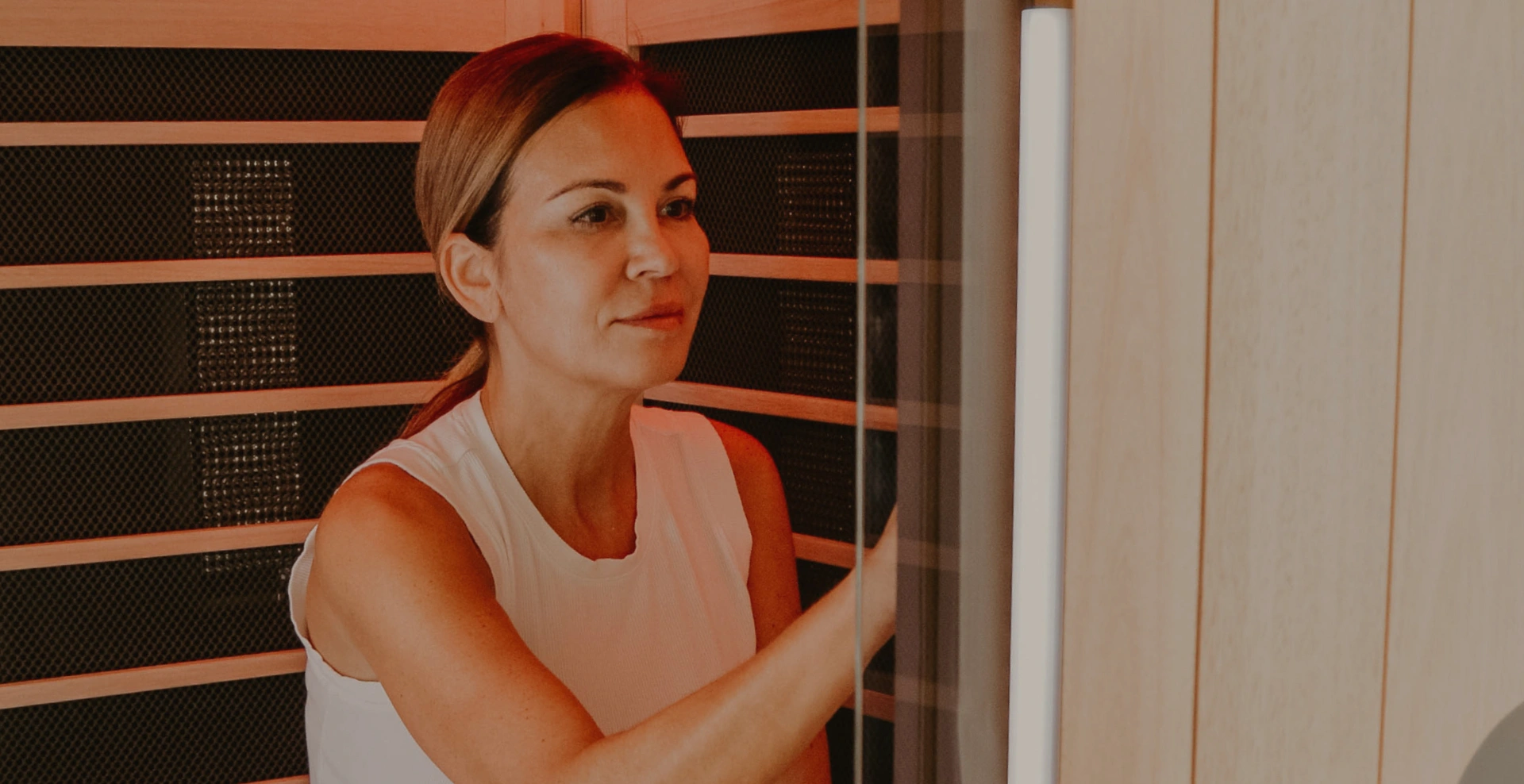
Infrared sauna: radiant heat. Infrared heaters (far, mid, near infrared and red light panels, depending on the sauna model) emit energy that your skin and tissue absorb directly. You feel warmed at a lower ambient air temperature and with lower humidity as the air inside the sauna stays cooler and dry. That's a mechanically different kind of heat exposure, not just a milder version of the same thing. Sunlighten recommends starting your session once the cabin reaches 100.4°F (38°C). Its optimal range runs from 100.4°F to 129°F (38–54°C), per the Amplify RED owner's manual.4 Some models, like the mPulse Intelligent Sauna and Amplify RED, add near infrared and red light alongside far infrared.
Infrared also adds a light effect that steam and traditional heat don't have. For what that means and how it works, see Infrared Sauna vs Steam Room: How Do Heat, Humidity and the Experience Differ?
Side-by-Side: Steam Room vs Traditional Sauna vs Infrared Sauna
Steam room
| Heat source | Steam generator boils water |
| How you're heated | Hot, saturated air |
| Typical air temperature | About 110–118°F¹ ² |
| Relative humidity | At or near saturation |
| Electrical | 220–240V generator circuit; electrician required |
| Plumbing | Cold water line to generator; drain |
| Waterproofing | Full membrane seal on every surface; sloped ceiling and floor |
| Ventilation | Dedicated exhaust fan to clear moisture |
| Install scope | Plumber and electrician; full waterproofing and a drain |
| Ongoing upkeep | Generator flushing; mold and mildew vigilance |
Traditional sauna
| Heat source | Electric or wood stove heats air and stones |
| How you're heated | Hot, dry air |
| Typical air temperature | About 176–212°F³ |
| Relative humidity | 10–20%, briefly higher with water on stones³ |
| Electrical | 240V hardwired; a 6–9 kW heater typically needs a 40–50A breaker⁵ |
| Plumbing | None (electric models) |
| Waterproofing | None |
| Ventilation | Intake and exhaust vents per heater manufacturer |
| Install scope | Electrician; high-amperage circuit and dedicated venting |
| Ongoing upkeep | Bench and floor care; stone replacement over time |
Infrared sauna
| Heat source | Infrared heater panels emit radiant energy |
| How you're heated | Radiant energy absorbed by skin and tissue |
| Typical air temperature | About 100–129°F, Sunlighten's recommended range⁴ |
| Relative humidity | Low |
| Electrical | 120V or 240V dedicated circuit, depending on model⁵ |
| Plumbing | None |
| Waterproofing | None |
| Ventilation | Standard room ventilation |
| Install scope | Electrician only, if a suitable dedicated circuit isn't already in place |
| Ongoing upkeep | Wipe-down; no plumbing to maintain |
A few things stand out in that table. The number of trades you need is the biggest practical difference: the steam room is the only one of the three that needs a plumber. Traditional saunas draw the most power: a 9 kW heater pulls about 37.5 amps, per a Haven of Heat wiring guide.5 Infrared saunas sit at the low end of power draw and skip plumbing entirely. Install cost varies too widely by scope, finish and local labor to compare usefully here, and the bigger budget driver is which trades the install requires. Current Sunlighten pricing is listed on sunlighten.com.
What to Consider Before You Choose
Space and placement
A steam room needs a sealed, sloped, waterproofed stall, so it fits best in a primary bathroom or other wet-rated space. A traditional sauna needs room for the stove, safe clearances around it, and proper venting. An infrared sauna is a freestanding cabin. It needs floor space and doorway clearance to move panels in, but no water line or drain.
Electrical vs plumbing
A steam room needs two trades: a plumber for the water line and an electrician for the generator. A traditional sauna needs an electrician and a heavy-duty circuit. A 6 kW heater calls for a 40A breaker and 8 AWG wire, per Haven of Heat.5 An infrared sauna needs an electrician only if you don't already have the right dedicated circuit. Sunlighten's mPulse Conquer and Amplify RED III each need a dedicated 240V 20A circuit, per Sunlighten specs.4,6
Moisture and mold
Humidity is the biggest long-term upkeep difference. The EPA identifies relative humidity above 70% at building surfaces as a mold-growth threshold.7 A steam room runs well above that every session, so drying and ventilation between uses aren't optional. Traditional saunas run dry most of the time. Infrared saunas run at low humidity throughout.
Power draw
Wattage tells you how much power each one pulls at full load. Traditional sauna heaters commonly run 6–9 kW, per Haven of Heat.5 The mPulse Conquer draws 3,600W, per its spec sheet.6 Sunlighten's Amplify models run on a dedicated 240V 20A circuit; current model-by-model wattage is listed on the product pages. Actual energy use also depends on warm-up time and session length.
How intense you want the heat
Humid heat tends to feel more intense at the same temperature, because your sweat can't evaporate to cool you. If you're new to heat or prefer a gentler session, dry infrared heat is an easier starting point. The full research breakdown is in Infrared Sauna vs Steam Room: How Do Heat, Humidity and the Experience Differ?
What you want it for
If recovery after workouts or winding down at night is your main goal, the evidence differs by heat type. Infrared's lower, drier heat lets most people stay in longer, while humid heat raises heart rate faster at the same temperature.
mPulse Conquer
| Capacity | 3-person (the mPulse line offers 1, 2, 3, 4 and 5 person cabins, plus custom builds) |
| Exterior footprint | 70.6"W x 47.6"D x 79"H |
| Electrical | 240V, 3,600W, 20A; dedicated 240V 20A circuit⁶ |
| Infrared spectrum | Patented SoloCarbon® heaters deliver infrared energy as soon as they're on. This model features 8 far infrared, 7 mid-infrared, 5 red light + near infrared heaters. |
| Integrated red light | Yes |
| Controls | PulseIQ™ infrared intelligence platform: independently controlled far, mid and near infrared plus red light. Built-in tablet has Wi-Fi enabled controls and connectivity. |
| Plumbing / waterproofing | None |
Amplify RED III
| Capacity | 3-person (the Amplify line offers 2, 3 and 4 person cabins) |
| Exterior footprint | 62.3"W x 45.9"D x 77.7"H |
| Electrical | Dedicated 240V 20A circuit⁶ |
| Infrared spectrum | Patented SoloCarbon® heaters deliver infrared energy as soon as they're on. This model features 7 far infrared, 5 red light + near infrared, 3 full spectrum heaters. |
| Integrated red light | Yes |
| Controls | Touch control panel sets timer, temperature and heat levels. This model controls RED/NIR wavelengths together, fully on or fully off. |
| Plumbing / waterproofing | None |
Source: Sunlighten spec sheets, Doc# 09142026 and 07242026 (Sunlighten internal documents).6
What sets the mPulse apart. The mPulse Intelligent Sauna pairs SoloCarbon® heaters with the PulseIQ™ infrared intelligence platform. It delivers far, mid and near infrared plus red light in one cabin. The mPulse uses wavelengths of 9.4 μm far, 6.7 μm mid, 880 nm near and 650 nm red, per Sunlighten internal engineering data. It suits you if you want the widest range of programs and the largest size options.
What sets the Amplify apart. The Amplify RED III builds red light into a compact cabin with a smaller footprint than the mPulse Conquer. It draws less power at full load, per Sunlighten specs.6 It suits you if red light is a priority and floor space is tighter.
What both share. Neither needs a water line, drain or waterproofing. Both include integrated red light, so you don't need a separate panel setup. Both use double-shielded wiring and the same red light and near infrared panel architecture. In 2020 third-party testing by Vitatech Electromagnetics, five Sunlighten cabins — the Amplify II, mPulse Believe, mPulse Conquer, Signature IV and Solo — measured 0.11–0.86 mG of magnetic field exposure at the user's torso. The mPulse Conquer, which has LED panels, measured 0.66 mG.10 That's well below the 12.57 mG reference level in the EN 55035:2017 standard the report uses. In separate 2020 air-quality testing, APEX Environmental Consultants measured total VOCs of 0.23–0.69 ppm inside three Sunlighten saunas running at 130°F.11 That's below the 1 ppm level the report associates with no expected health effects or occupant complaints. Most compounds detected were also in the building's background air at similar or higher levels. The Amplify RED line launched after those tests and is built with the same wiring, materials and LED panel architecture as the cabins that were tested.
Checking Two Common Claims
“Steam helps you breathe easier when you're congested.” This is one of the most common reasons people cite for wanting a steam room. The evidence is weaker than the claim. A Cochrane review of six randomized trials (387 participants) found no reliable benefit from heated, humidified air for the common cold.8 Steam may feel soothing, but it isn't a proven congestion treatment.
“Sweating in an infrared sauna detoxes your body.” Sweat plays a supporting role. Your liver and kidneys do most of the work of filtering and clearing waste, and sweat carries out only small amounts of some substances, including heavy metals, per a Science-Based Medicine review.9 Think of a session as one part of a healthy routine, not a replacement for your body's own filters. (On whether steam actually makes you sweat more than infrared, see Infrared Sauna vs Steam Room: How Do Heat, Humidity and the Experience Differ?)
Choose a Steam Room When…
You love humid heat and find dry heat uncomfortable. You're building into a wet-rated space like a primary bathroom, where a sealed stall fits naturally. And you're ready to take on plumbing, waterproofing and regular mold prevention.
Choose a Traditional Sauna When…
You want the classic Finnish experience: very hot air, the ritual of water on stones, and the most intense heat of the three. You have the electrical capacity for a high-amperage heater, or you're planning an outdoor build with a wood stove. And you're comfortable with longer warm-up before each session.
Choose an Infrared Sauna When…
You want the simplest install: electrical only, no plumbing or waterproofing. You'd rather wipe down a cabin than maintain a drain and ventilation system. You want a gentler heat to start with, or a lower air temperature that's easier to stay in longer. Or you want red light built in, which both the mPulse Conquer and Amplify RED III include.
Frequently Asked Questions
Which is easiest to install at home: steam room, traditional sauna or infrared sauna?
An infrared sauna is usually the simplest. It needs a dedicated electrical circuit but no plumbing, drain or waterproofing. A steam room needs both a plumber and an electrician. A traditional sauna needs a high-amperage circuit and proper venting.
Which one gets the hottest?
A traditional sauna. Finnish saunas typically run at 176–212°F, per a 2018 Mayo Clinic Proceedings review.3 Steam rooms run about 110–118°F but feel intense because the air is saturated, so sweat can't evaporate.1,2 Infrared saunas run at lower air temperatures, about 100–129°F per Sunlighten's guidance, because they warm your body directly.4
Will a home steam room grow mold?
It can. The EPA identifies relative humidity above 70% at building surfaces as a mold-growth threshold.7 A steam room runs well above that during every session. Consistent ventilation and drying between uses are required.
Which uses the most electricity?
A traditional sauna typically draws the most power at full load. Its heaters commonly run 6–9 kW, per Haven of Heat.5 Sunlighten's mPulse Conquer draws 3,600W, per its spec sheet.6
Which costs more to install?
It depends far more on scope and local labor than on the type of heat, so a single figure isn't meaningful. The more useful comparison is how many trades the install requires. A steam room needs both a plumber and an electrician, plus waterproofing and a drain. A traditional sauna needs an electrician for a high-amperage circuit, plus venting. An infrared sauna needs an electrician only if you don't already have a suitable dedicated circuit. Current Sunlighten pricing is listed on sunlighten.com.
Can I put an infrared sauna anywhere in my house?
Almost. You need a dedicated circuit near the install spot and enough doorway clearance to move panels in. You don't need a water line or drain, which gives you more placement options than a steam room.
Sources cited
- Mr.Steam. Installation, Operation and Maintenance Manual, Steambath Generator Systems, Doc. PUR100547 Rev. 10.25. Link
- This Old House. All About Steam Showers: How They Work, Cost and Installation. Link
- Laukkanen JA, Laukkanen T, Kunutsor SK. Cardiovascular and other health benefits of sauna bathing: a review of the evidence. Mayo Clin Proc. 2018. Link
- Sunlighten. Amplify RED Owner's Manual, Version 082026.
- Haven of Heat. Sauna Electrical Requirements: 240V vs 120V Wiring Guide. Link
- Sunlighten. mPulse Conquer and Amplify RED III spec sheets, Doc# 09142026 and 07242026 (internal documents).
- US Environmental Protection Agency. Moisture Control Guidance for Building Design, Construction and Maintenance. Link
- Cochrane. Heated, humidified air for the common cold. Cochrane Database Syst Rev. 2017. Link
- Novella S. Infrared saunas for “detoxification.” Science-Based Medicine. 2021. Link
- Vitatech Electromagnetics. Sunlighten Sauna EMI Test, Document VTE-3200. 2021. Link
- APEX Environmental Consultants. Air Quality Testing Inside Operating Sauna Units, Project No. 200237IH. 2020. Link