Written by: Bri Partridge
Published on: Oct. 21, 2026
What Should You Consider Before Choosing?
Steam Room or Infrared Sauna at Home
How Each One Actually Heats You
A steam room works by boiling water in a generator and piping the vapor into a fully sealed, waterproofed stall, saturating the air to close to 100% relative humidity at around 110–120°F. You're heated by humid air warming your skin, and because sweat can't evaporate into already-saturated air, your body's main cooling mechanism is largely shut down for the duration.
An infrared sauna, like the mPulse Conquer or Amplify RED III, doesn't heat the air to the same degree. Instead, infrared heaters (far, mid, near infrared and red light panels, depending on the model) emit radiant energy that's absorbed directly by your skin and tissue, so you feel warmed at a lower ambient air temperature and with low humidity. That's a mechanically different kind of heat exposure, not just a milder version of the same thing.
Wavelengths also change what's actually happening to your body, not just how warm it feels. Far infrared heats primarily because water molecules in skin and tissue absorb that radiant energy. Near infrared and red light work differently: they're absorbed by cytochrome c oxidase, an enzyme inside your cells' mitochondria, at wavelengths researchers place around 600–700 nm and 780–1,100 nm. That absorption triggers a cellular signaling response rather than generating heat — a mechanism researchers call photobiomodulation. A multi-wavelength infrared sauna is layering two distinct effects: a thermal one from far infrared, and a separate, non-thermal one from near infrared and red light. A steam room only ever produces the first kind of exposure — humid convective heat.
What Each Option Actually Requires at Home

Steam room
| Typical capacity | Varies by build |
| Exterior footprint | Varies by build; must fit a sealed, sloped stall |
| Electrical | 220–240V generator circuit, electrician required |
| Plumbing | Cold water line to generator; generator typically within ~25 ft of stall |
| Waterproofing | Full membrane or liquid-polymer seal on every surface, sloped ceiling and floor, sealed penetrations |
| Ventilation | Dedicated exhaust fan recommended to manage residual moisture |
| Typical install cost | $2,800–$25,000+ depending on size/finish, plus a $600–$2,500 generator (contractor estimates via Angi/HomeAdvisor, accessed October 2026) |
| Ongoing maintenance | Regular generator flushing (roughly every 20 sessions if manual), mold/mildew vigilance between uses |
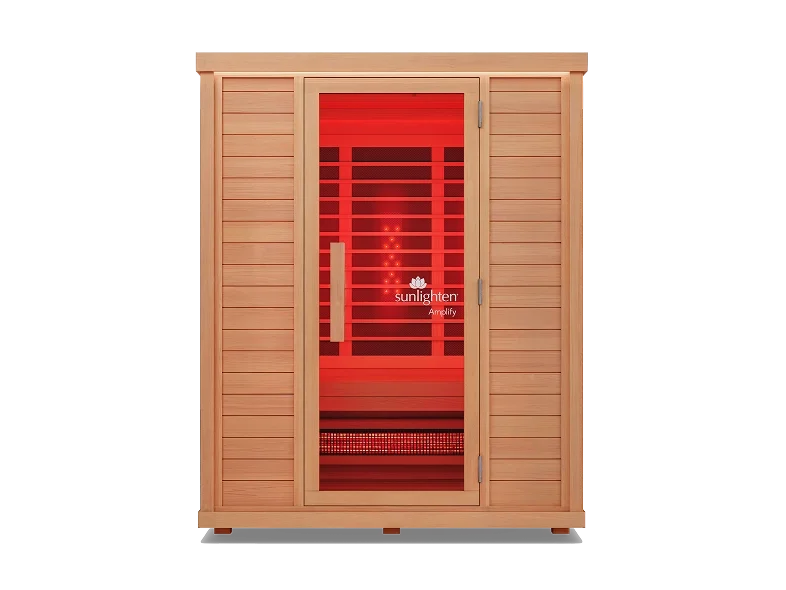
Amplify RED III
| Typical capacity | 3-person (This collection offers 2 to 4 person cabins) |
| Exterior footprint | 62.3"W x 45.9"D x 77.7"H |
| Electrical | 240V, 3280W, 13.67A — dedicated 240V 20A circuit |
| Plumbing | None — plug-in electrical only |
| Waterproofing | None required |
| Ventilation | Standard room ventilation |
| Typical install cost | Pricing listed on sunlighten.com |
| Ongoing maintenance | Wipe-down; no plumbing to maintain |

mPulse Conquer
| Typical capacity | 3-person (This collection offers 1 to 5 person cabins, plus larger custom builds) |
| Exterior footprint | 70.6"W x 47.6"D x 79"H |
| Electrical | 240V, 3600W, 20A — dedicated 240V 20A circuit |
| Plumbing | None — plug-in electrical only |
| Waterproofing | None required |
| Ventilation | Standard room ventilation |
| Typical install cost | Pricing listed on sunlighten.com |
| Ongoing maintenance | Wipe-down; no plumbing to maintain |
A few things worth calling out from that table. First, steam room costs vary enormously by whether you're converting an existing shower (around $2,600) or building a dedicated room from scratch ($22–$130 per square foot, per Angi and HomeAdvisor) — so “steam room” isn't one price point, it's a range that depends heavily on your contractor and finish level. Second, both Sunlighten saunas need their own dedicated 240V 20A circuit regardless of their different wattage draws, so an electrician visit is a planning step either way — it's just a different trade (electrician only) versus two trades (electrician and plumber) for a steam room.
Does the Humidity Actually Matter? What the Research Shows
It's not just a comfort preference — humidity changes how hard your body works. A 2026 University of Jyväskylä study (with the Finnish Institute of High Performance Sport) put 50 adults through four 10-minute Finnish sauna sessions, measuring air temperature and relative humidity at sitting and head height and analyzing each as an independent predictor of physiological strain. Heart rate rose from an average of 79 to 121 beats per minute and core temperature rose about 0.4°C across a session. Both heat and humidity independently drove that response: each additional 1% of relative humidity was associated with roughly 0.37 more beats per minute and 0.008°C more core temperature, on top of the effect of air temperature itself. The mechanism is straightforward — high humidity limits sweat evaporation, which is the body's primary cooling route, so the same air temperature costs the body more when the air is wet.
Two limits are worth stating plainly. The study measured Finnish saunas running at roughly 28–54% relative humidity, not steam rooms at close to 100%, so it establishes the direction of the effect without telling you its size at steam-room humidity. And it did not compare a dry condition against a humid one — humidity varied continuously as bathers threw water on the stones. The authors' own summary is that perceived strain was driven primarily by temperature, with smaller contributions from humidity.
That's a reason some people prefer starting with dry infrared heat — it's a gentler on-ramp to heat exposure — while others who already tolerate heat well may prefer steam's more intense physiological response. Separately, the well-known Finnish sauna research linking frequent sauna use to lower cardiovascular mortality (Laukkanen et al.) studied traditional dry/low-humidity Finnish saunas specifically — it's relevant context for heat exposure generally, but it isn't infrared-specific evidence, and it isn't steam-specific either.
Myth-Checking the Two Most Common Claims
“Steam helps you breathe easier when you're congested.” This is one of the most common reasons people cite for wanting a steam room. The evidence is weaker than the claim: a Cochrane review of six randomized trials (387 participants) on heated, humidified air for the common cold found no reliable benefit — results were inconsistent across studies and rated as low-quality evidence. Steam may feel subjectively soothing, but it isn't a verified treatment for congestion.
“Sweating in an infrared sauna detoxes your body.” This claim gets made about infrared saunas specifically, and it doesn't hold up well either. An independent review on Science-Based Medicine notes that sweat removes only trivial amounts of substances like heavy metals — the liver and kidneys do that work — and that a 2018 review found just 13 small, randomized trials (mostly under 40 participants) on sauna use generally, with inconsistent outcomes. Infrared sauna use does produce measurable short-term changes in heart rate and blood flow, but those are a normal heat-exposure response, not evidence of detoxification.
Choose a Steam Room When…
You want humid heat specifically — for comfort, tradition, or because you find dry heat less pleasant — and you're prepared to take on the plumbing, waterproofing, and mold-prevention upkeep that comes with it. It's also the right call if you're building into an already wet-rated space (like a primary bathroom) where a sealed stall is a natural fit.
Choose an Infrared Sauna When…
You want a simpler install — electrical only, no plumbing or waterproofing — and you'd rather manage a wipe-down than a drainage and ventilation system. It's also worth considering if you want to start with a gentler heat exposure before working up to more intense sessions, or if you want integrated red light therapy without a separate panel setup, which both the Amplify RED III and mPulse Conquer include.
What We Still Don't Know
Exact published operating temperature and humidity ranges for mPulse and Amplify models weren't in the spec sheets used for this piece, so it uses Sunlighten's published category guidance instead (100–150°F cabin range, 110–130°F for a typical session, roughly 25–35% relative humidity); per-model operating specs should be confirmed with product before any piece states them. The 2026 Jyväskylä study establishes that humidity independently contributes to physiological strain, but it measured Finnish saunas at 28–54% relative humidity in 10-minute sessions with a mostly habitual-bather sample, and humidity varied continuously rather than being compared against a dry control — so what happens at steam-room humidity remains an extrapolation rather than a measured result. Steam room installation and generator figures are contractor-estimate ranges from cost aggregators (Angi, HomeAdvisor; accessed October 2026) rather than Sunlighten-specific pricing, since steam rooms aren't a single branded product; they vary substantially by scope, and the conversion-versus-new-build distinction matters more than the headline range.
Frequently Asked Questions
Does a steam room need professional installation?
Can I put an infrared sauna anywhere in my house?
Is steam or infrared heat harder on your cardiovascular system?
Will a home steam room grow mold if I'm not careful?
Does infrared sauna use actually detoxify the body?
Sources cited
- de Freitas & Hamblin (2016), IEEE JSTQE — Proposed Mechanisms of Photobiomodulation or Low-Level Light Therapy. Link
- Laatikainen-Raussi et al., University of Jyväskylä (2026) — steam and physiological strain during sauna bathing. Link
- Cochrane Review — Heated, humidified air for the common cold. Link
- Science-Based Medicine — Infrared Saunas for Detoxification
- EPA — Moisture Control Guidance (mold growth thresholds)
- This Old House — How a Steam Shower Works. Link
- Angi — Steam Shower Cost Guide
- HomeAdvisor — Steam Shower Installation Cost
- mPulse Conquer and Amplify RED III spec sheets (Sunlighten internal documents, Doc# 09142026 and 07242026)